.webp&w=1920&q=82)
.webp&w=1920&q=82)
.webp&w=1920&q=82)
.webp&w=1920&q=82)
.webp&w=1920&q=82)
.webp&w=1920&q=82)
.webp&w=1920&q=82)
.webp&w=1920&q=82)
.webp&w=1920&q=82)
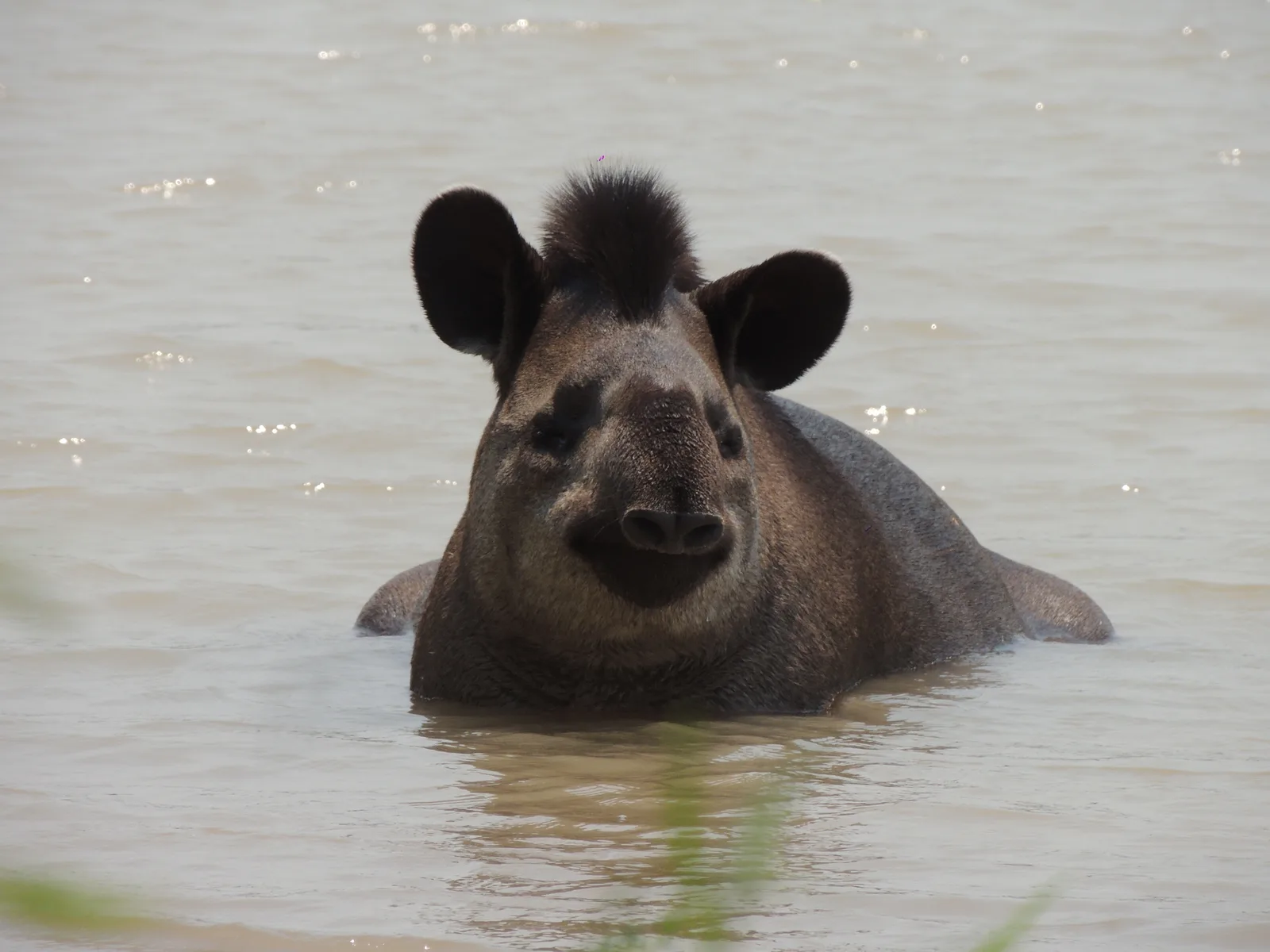
Lowland tapir
Tapirus terrestris
Mammals — Perissodactyls (Tapiridae)
The lowland tapir is South America's largest terrestrial mammal and one of the species most important to tropical forest dynamics. Elusive and powerful, it serves as an ecological engineer and super-disperser of seeds, connecting landscapes and fostering forest regeneration on a vast scale.
Gardener of South American forests
A large species with nocturnal-crepuscular habits, the lowland tapir ranges over broad areas in search of food and water. This constant movement makes it one of the principal dispersers of large seeds in Brazilian forests.
📍 Biomes it inhabits
It occurs in the Amazon, the Cerrado — the Brazilian savanna —, the Atlantic Forest, the Pantanal — the world's largest tropical wetland —, and humid parts of the Caatinga. In Brazil, it is associated with continuous forests, flood-prone areas, riparian forests, and landscapes with permanent access to water.
🌍 Conservation status (IUCN)
VU · VulnerableAccording to the IUCN, the species is classified as VU (Vulnerable). Hunting, habitat fragmentation, and vehicle collisions are the main threats across much of its range.
🔬 Scientific classification
- Kingdom
- Animalia
- Phylum
- Chordata
- Class
- Mammalia
- Order
- Perissodactyla
- Family
- Tapiridae
- Genus
- Tapirus
- Species
- Tapirus terrestris (Linnaeus, 1758)
⚙️ Specifications and metrics
- Body mass: 150–300 kg (330–660 lb).
- Body length: 1.80–2.50 m (5.9–8.2 ft).
- Snout: Short and prehensile, used for feeding and exploring its surroundings.
- Locomotion: Robust limbs with three functional toes, adapted to wet and uneven terrain.
- Physiology: An excellent swimmer, using water as a refuge.
- Generation length: ~11–12 years — slow population recovery.
Diet: Herbivorous — leaves, shoots, fruits, and branches; consumes hundreds of plant species throughout the year.
📅 Life cycle
- Gestation: ~390–400 days; generally 1 calf.
- Development: Calves are born with a pattern of spots and stripes.
- Parental care: Exclusively maternal.
- Lifespan: 25–30 years in the wild; longer under human care.
🔗 Ecological ripple effect
As a mega-disperser of seeds, the lowland tapir sustains forests' genetic and structural diversity. Its loss results in impoverished forests, with fewer large trees and altered plant composition.
🤔 Why it matters
- Brazil's largest terrestrial mammal.
- Disperses seeds over long distances.
- Uses fixed trails throughout its territory.
- Highly sensitive to habitat fragmentation.
🧪 Did you know?
- It is considered an umbrella species for forest conservation.
- Calves have camouflage resembling that of wild boar piglets.
- The name Tapirus derives from Indigenous languages.
- Protecting the lowland tapir benefits dozens of other species.
Small discoveries
- Nocturnal-crepuscular
- Activity that occurs predominantly at night and at twilight.
- IUCN
- International Union for Conservation of Nature — the global authority on extinction-risk assessment.
- Prehensile
- A flexible structure formed by the fusion of the upper lip and nose.