.webp&w=1920&q=82)
.webp&w=1920&q=82)
.webp&w=1920&q=82)
.webp&w=1920&q=82)
.webp&w=1920&q=82)
.webp&w=1920&q=82)
.webp&w=1920&q=82)
Two-spotted spider mite
Tetranychus urticae
Arachnids — Acari: Trombidiformes (Tetranychidae)
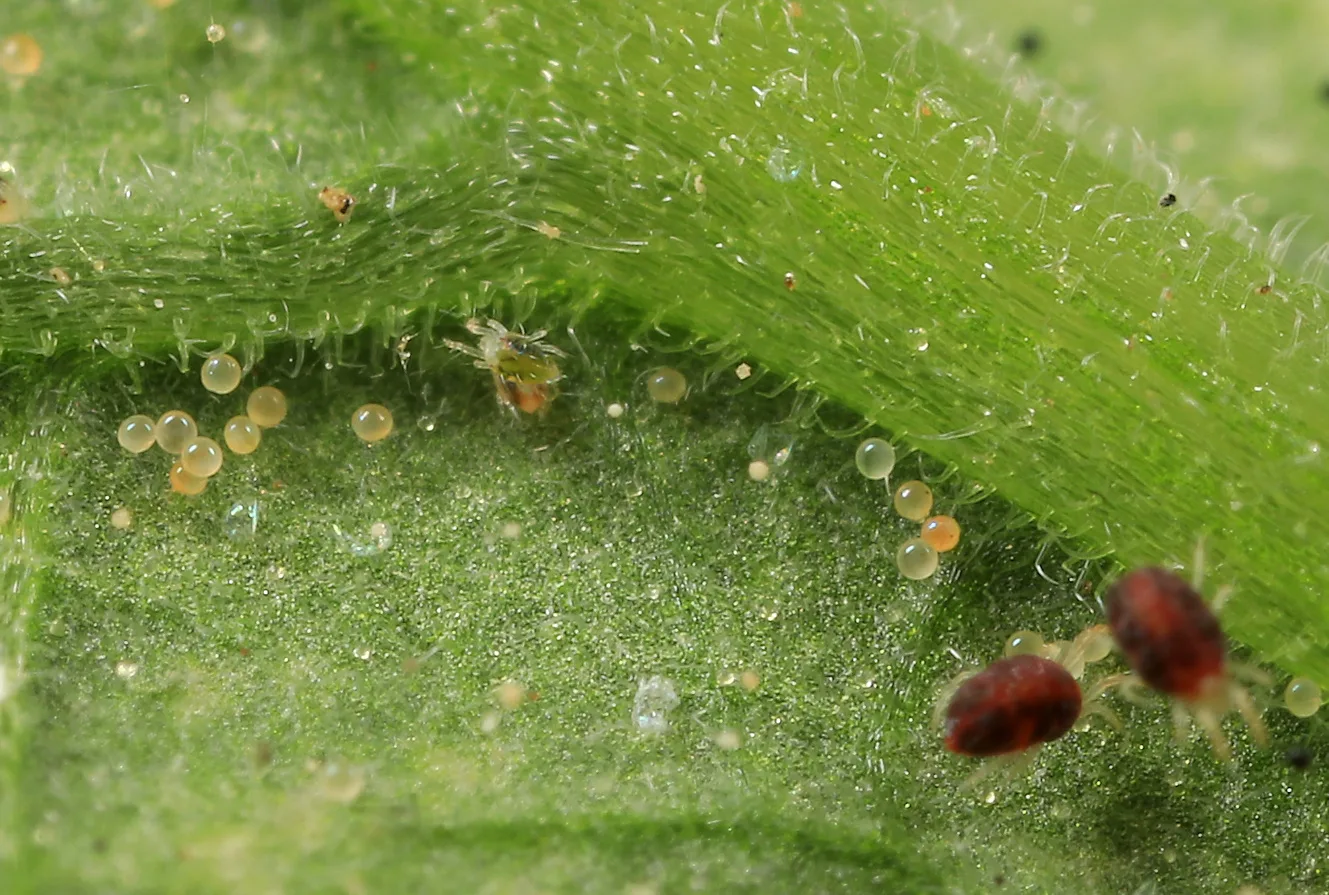
Almost invisible to the naked eye, the two-spotted spider mite is among the organisms with the greatest economic impact on modern agriculture. Able to infest hundreds of different plants, Tetranychus urticae is an extreme example of how microscopic organisms can alter entire ecosystems and global production systems.
The invisible enemy of leaves
Unlike conspicuous insects, the two-spotted spider mite works in silence. It settles mainly on the undersides of leaves, where it pierces plant cells to feed. The result is a characteristic pattern of chlorotic stippling, which sharply reduces a plant's capacity for photosynthesis.
📍 Range and habitat
Distribution: cosmopolitan — present on virtually every continent, including all of Brazil.
Habitat: associated with cultivated and wild plants, especially in hot, dry environments. It infests vegetables, fruit crops, ornamentals, and large-scale field crops.
⚠️ Relationship with humans
Conservation: a species without a specific formal IUCN assessment. It is extremely abundant and adaptable.
Relationship: considered one of the world's leading agricultural pests. It poses no direct risk to human health, but causes major economic losses.
🔬 Scientific classification
- Kingdom
- Animalia
- Phylum
- Arthropoda
- Class
- Arachnida
- Order
- Trombidiformes
- Family
- Tetranychidae
- Genus
- Tetranychus
- Species
- Tetranychus urticae Koch, 1836
🔬 Morphology and adaptations
- Size: Extremely small, at about 0.4–0.6 mm (0.02 in).
- Coloring: Variable — greenish, yellowish, or reddish, usually with two dark lateral spots.
- Legs: Four pairs, a trait typical of arachnids.
- Silk: Produces fine webs over leaves, used for protection and travel.
Diet: Plant feeder — pierces plant cells on the undersides of leaves to feed on their contents.
🔄 Life cycle and behavior
📅 Development
- Type: a rapid cycle that can be completed in less than two weeks.
- Reproduction: sexual and parthenogenetic reproduction.
🌙 Behavior
- Population outbreaks: common in hot, dry weather.
- Resistance: rapid evolution of pesticide resistance.
- Dispersal: can spread by wind and plant material.
🌱 Ecological and Agricultural Impact
- Lower productivity: weakens plants by drawing out cell contents.
- Plant stress: leaves dry out, yellow, and may fall.
- Ecological imbalances: outbreaks are favored by the removal of natural predators.
🛑 Management and Control
- Biological control: use of predatory mites (Phytoseiidae).
- Integrated management: combining agricultural practices with constant monitoring.
- Judicious use of chemicals: to prevent resistance.
💫 What Does the Two-Spotted Spider Mite Teach Us?
Tetranychus urticae proves that size is not the same as impact. On a microscopic scale, it challenges modern agriculture and compels the development of more intelligent, sustainable strategies.
To understand this mite is to understand the importance of ecological balance — including in agricultural systems.
Reflection: when we overlook the smallest organisms, they are the ones that end up controlling the system.
Small discoveries
- Chlorotic stippling
- Pale spots caused by the destruction of leaf cells.
- Photosynthesis
- The process by which plants produce energy from light.
- IUCN
- The global list of threatened species; agricultural pests are not the focus of risk assessments.
- Leading agricultural pests
- Organisms that cause significant economic losses in agriculture.
- Phytoseiidae
- Mites that feed on pest mites.
- Parthenogenetic
- A system in which unfertilized eggs give rise to males.