.webp&w=1920&q=82)
.webp&w=1920&q=82)
.webp&w=1920&q=82)
.webp&w=1920&q=82)
Black-and-gold Cotinga
Tijuca atra
Birds — Passeriformes (Cotingidae)
Before coming into view, the Black-and-gold Cotinga usually arrives as sound: a high, fine whistle climbing through the mountain mist. In the highland forests of southeastern Brazil, black males with golden wings answer one another until they turn the canopy into a continuous chorus.
The whistle that gives voice to the mountains of the Atlantic Forest.
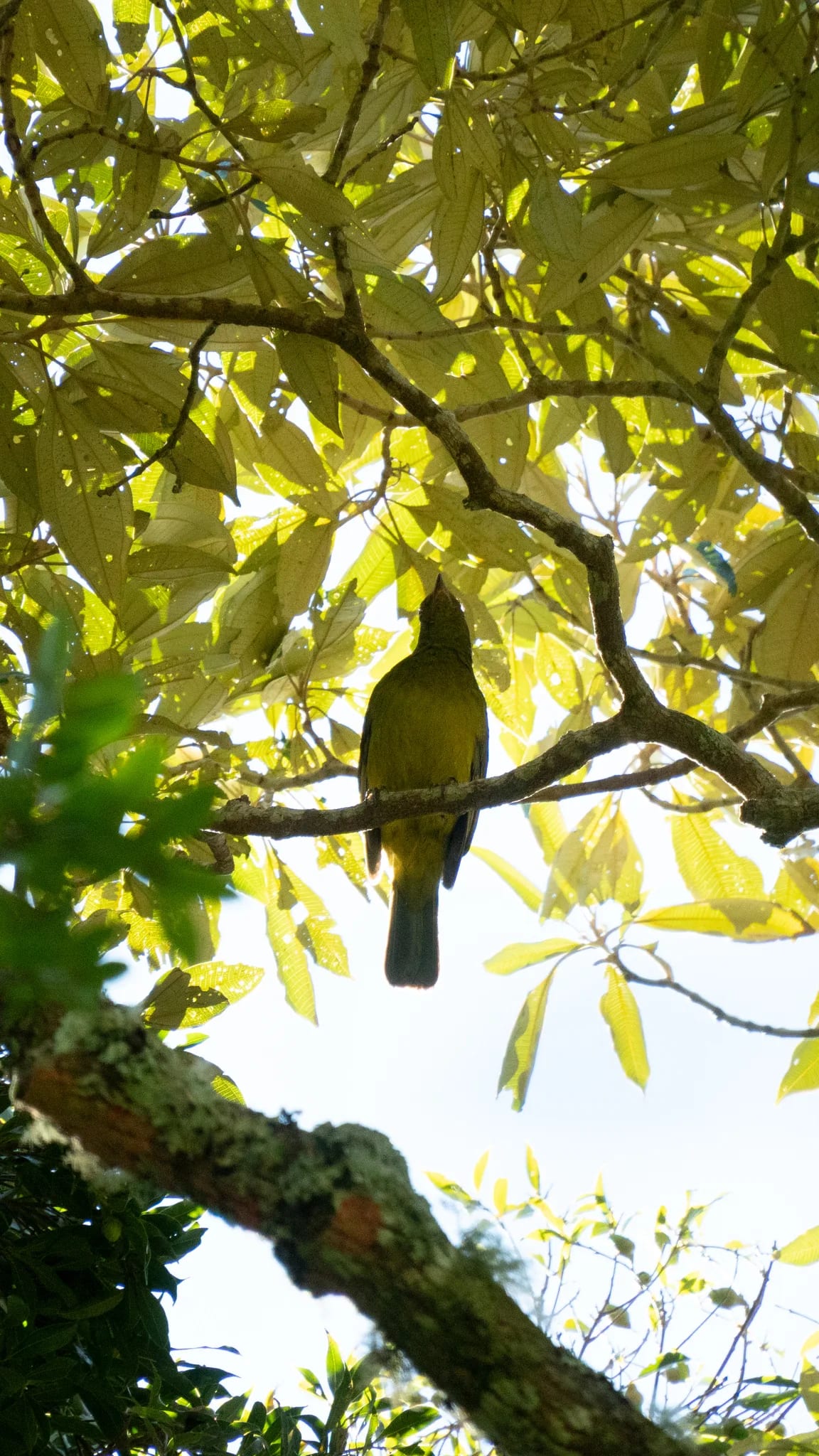
The Black-and-gold Cotinga, Tijuca atra, is a mountain-forest cotinga and a Brazilian endemic: it occurs naturally only in the country. Restricted to the ranges of the Southeast, it is easily overlooked among the foliage, yet its voice is impossible to ignore. The male joins black plumage with intense yellow wings; the olive-green female tends to blend into the forest. The species is monotypic, meaning it has no recognized subspecies.
📍 Biomes it inhabits
In the Atlantic Forest, the Black-and-gold Cotinga chiefly occupies humid high-elevation forests in the Mantiqueira, Serra do Mar, and Serra dos Órgãos ranges, in Minas Gerais, São Paulo, and Rio de Janeiro. There, the dense, uneven forest of the slopes offers both fruit and high singing perches. Although resident year-round, some individuals may descend to lower elevations outside the breeding season.
🌍 Conservation status (IUCN)
LC · Least ConcernThe IUCN Red List classifies the Black-and-gold Cotinga as Least Concern globally, according to a BirdLife International assessment published in 2019. That category does not lessen the value of its protection: the species occupies a restricted mountain range and depends on well-preserved humid forests. Loss, fragmentation, and degradation of the Atlantic Forest may isolate populations and reduce the places available for feeding, singing, and breeding.
🔬 Scientific classification
- Kingdom
- Animalia
- Phylum
- Chordata
- Class
- Aves
- Order
- Passeriformes
- Family
- Cotingidae
- Genus
- Tijuca
- Species
- Tijuca atra Ferussac, 1829
⚙️ Specifications and metrics
- Length: Between 25 and 28 cm (9.8 to 11 in).
- Body mass: No reliable body-mass data were found.
- Plumage: The male is black, with a large bright-yellow patch on the flight feathers and an orange bill; the female is olive green, paler on the underparts.
- Vocalization: A long, very pure, high-pitched whistle that rises in pitch and pauses briefly before the final note; males may alternate it in chorus, creating an almost continuous sequence.
Diet: The Black-and-gold Cotinga is chiefly frugivorous. It searches for fruit in the canopy and understory, especially on trees in the family Lauraceae, perching among the foliage, stretching to pluck its food, and sometimes making short flights to reach it. It also takes insects occasionally, with brief sallies into foliage or the air. There is not enough published description to establish a specific seasonal variation in its diet.
📅 Life cycle
- Reproduction: Breeding activity appears to be concentrated between September and November. At this time, males sing and display in groups, while females visit the singing areas.
- Nest: There is a historical mention of a nest found in November, but its architecture, location, and materials have not been reliably described.
- Incubation: There are no reliable published data on the duration of incubation.
- Lifespan: No reliable longevity data were found.
🔗 Ecological ripple effect
When a frugivorous bird disappears, the forest loses one of its agents of seed movement. The Black-and-gold Cotinga swallows fruit and moves among trees, potentially carrying seeds to other parts of the forest; its absence tends to weaken that ecological connection, especially for plants whose fruit it eats. It would also silence a striking element of the soundscape of highland forests, a sign of a still-functioning canopy community.
🤔 Why it matters
- It helps connect fruiting trees in the forest by carrying seeds as it moves.
- It is a Brazilian endemic associated with the mountains of the Atlantic Forest, one of the country’s most distinctive environments.
- Its far-carrying song makes the species important for acoustic surveys and for assessing the quality of mountain forests.
- The males’ alternating chorus is a rare display behavior and is relevant to the study of the evolution of cotinga breeding systems.
- The popular name saudade—a Portuguese word for wistful longing—preserves a direct cultural association between the bird and the melancholy character of its whistle.
🧪 Did you know?
- The full whistle lasts about three seconds and rises gradually in frequency before a short pause and the final note.
- Two or more males may alternate whistles so that the sound seems to have no interval; this chorus becomes more frequent when a female approaches.
- A classic study described the males’ collective display as a form of behavior with no known equivalent among birds at the time of the research.
- The Black-and-gold Cotinga is endemic to Brazil and tied to the humid mountain ranges of the Southeast; it does not occur naturally in any other country.
- Outside the breeding season, individuals have been recorded at elevations below their usual mountain range.
Small discoveries
- Frugivorous
- Feeding chiefly on fruit.
📚 References
- BirdLife International. 2019. Black-and-gold Cotinga Lipaugus ater. Lista Vermelha da IUCN.
- Snow, D. W.; Goodwin, D. 1974. The Black-and-Gold Cotinga. The Auk, 91: 360-369.
- Snow, D.; Sharpe, C. J. 2021. Black-and-gold Cotinga Lipaugus ater. Birds of the World.
- eBird. Black-and-gold Cotinga Lipaugus ater.
- WikiAves. Saudade Lipaugus ater.
- GBIF — Tijuca atra