.webp&w=1920&q=82)
.webp&w=1920&q=82)
.webp&w=1920&q=82)
.webp&w=1920&q=82)
.webp&w=1920&q=82)
.webp&w=1920&q=82)
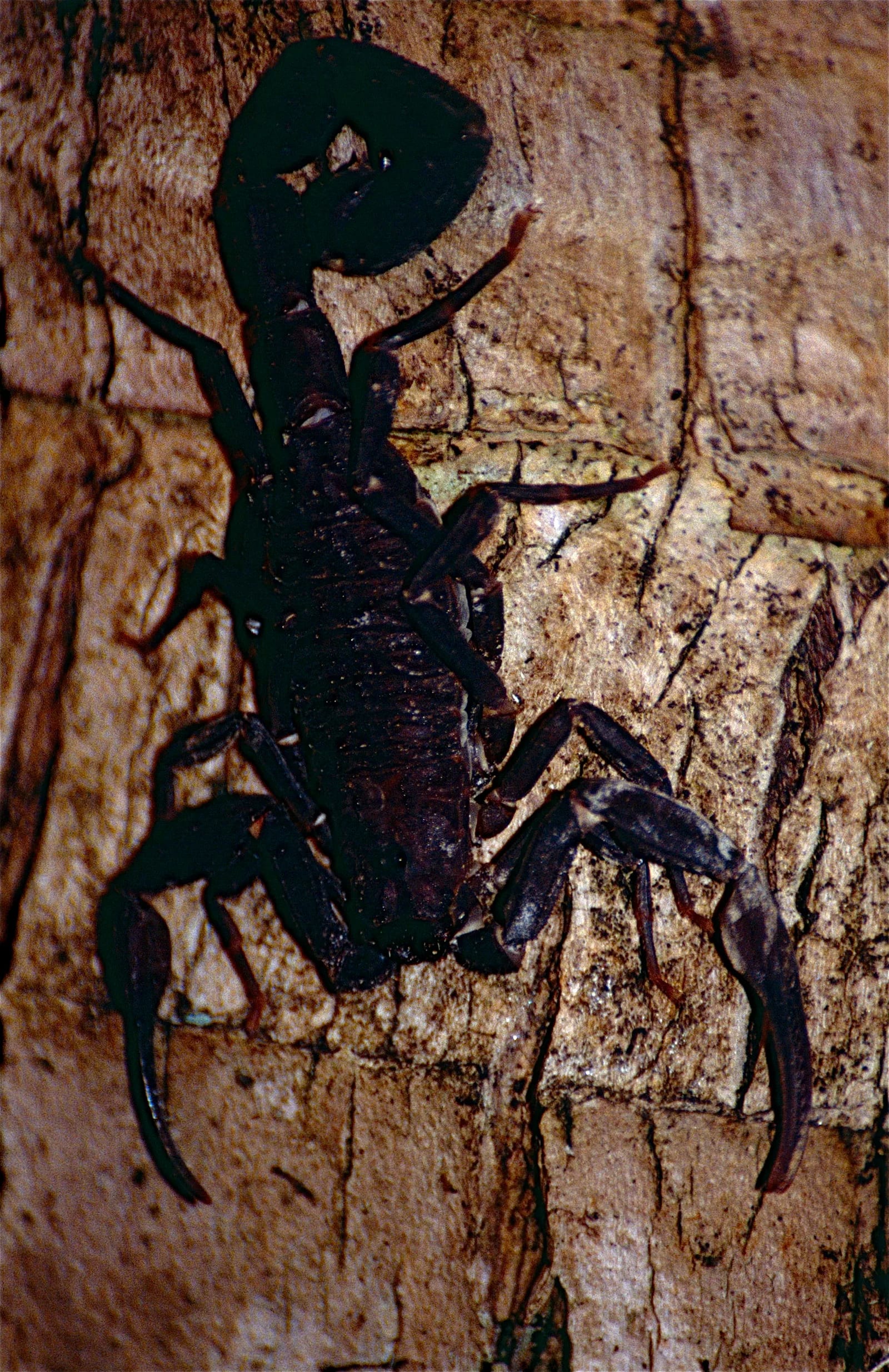
Amazonian black scorpion
Tityus obscurus
Arachnids — Scorpiones (Buthidae)
Large, dark, and clinically significant, the Amazonian black scorpion is one of the species of greatest medical importance in northern Brazil. Tityus obscurus is associated with potentially serious accidents, with neurologic manifestations distinct from those observed in other Brazilian scorpions.
The Amazonian scorpion with unpredictable venom
Unlike the urban yellow scorpion, Tityus obscurus is a species typical of the Amazon, associated with forest and rural environments. Its stings are less frequent in absolute numbers, but often more complex, involving neurologic symptoms that require immediate, specialized medical attention.
📍 Range and habitat
Distribution: Brazil's Amazon region, especially Pará, Amapá, Amazonas, and adjacent areas, with additional records in northern South America.
Habitat: tropical forests, rural areas, riverside communities, woodpiles, palms, logs, and forest floors.
⚠️ Relationship with humans
Conservation: species with no specific formal IUCN assessment. It is relatively common in natural Amazonian environments.
Relationship: species of high regional medical importance. Its neurotoxic venom can cause serious neurologic conditions. Every sting requires immediate medical care, even when the initial pain seems mild.
🔬 Scientific classification
- Kingdom
- Animalia
- Phylum
- Arthropoda
- Class
- Arachnida
- Order
- Scorpiones
- Family
- Buthidae
- Genus
- Tityus
- Species
- Tityus obscurus (Gervais, 1843)
🔬 Morphology and adaptations
- Size: A medium- to large-sized scorpion that can exceed 8 cm (3.1 in).
- Coloring: Dark brown to black, providing camouflage in the forest environment.
- Stinger: Robust, with a well-developed venom gland.
- Pedipalps: Relatively long and slender, typical of the genus Tityus.
Diet: A nocturnal predator of insects and other small forest-dwelling invertebrates.
🔄 Life cycle and behavior
📅 Development
- Type: growth through molts.
- Reproduction: sexual reproduction, unlike some urban species in the genus.
- Lifespan: estimated at several years.
🌙 Behavior
- Activity: predominantly nocturnal.
- Habits: terrestrial and concealed, taking shelter during the day.
- Defense: stings quickly when handled or compressed.
🩺 Medical Importance
- Symptoms: local pain, tremors, agitation, impaired motor coordination, confusion, and muscle spasms.
- Clinical profile: distinct from classic scorpionism in southeastern Brazil, with a strong neurologic component.
- Treatment: scorpion antivenom may be necessary; hospital monitoring is often indicated.
🛑 Prevention and Coexistence
- Wear gloves when handling wood, leaves, and organic materials.
- Avoid accumulating logs, palm fronds, and clutter near homes.
- Keep beds away from walls in rural areas.
- Seek immediate medical care in the event of a sting.
💫 Why does the Amazonian black scorpion warrant attention?
Tityus obscurus is a reminder that biological risk in Brazil is not confined to cities. In the Amazon, accidents are less visible but often more complex.
Knowing this species is a matter of regional public health, but also of respect for Amazonian ecosystems.
Reflection: protecting human lives in the forest begins with knowing the species that live there — not through fear, but through sound information.
Small discoveries
- Potentially serious
- Clinical cases requiring medical evaluation and follow-up.
- Neurologic
- Changes in the nervous system, such as tremors, impaired coordination, and confusion.
- Forest floors
- Humid environments with accumulated organic matter.
- IUCN
- The global list of threatened species; Amazonian scorpions do not receive individual assessments.
- Neurotoxic venom
- Venom that can intensely affect the central nervous system.