.webp&w=1920&q=82)
.webp&w=1920&q=82)
.webp&w=1920&q=82)
.webp&w=1920&q=82)
.webp&w=1920&q=82)
.webp&w=1920&q=82)
.webp&w=1920&q=82)
.webp&w=1920&q=82)
.webp&w=1920&q=82)
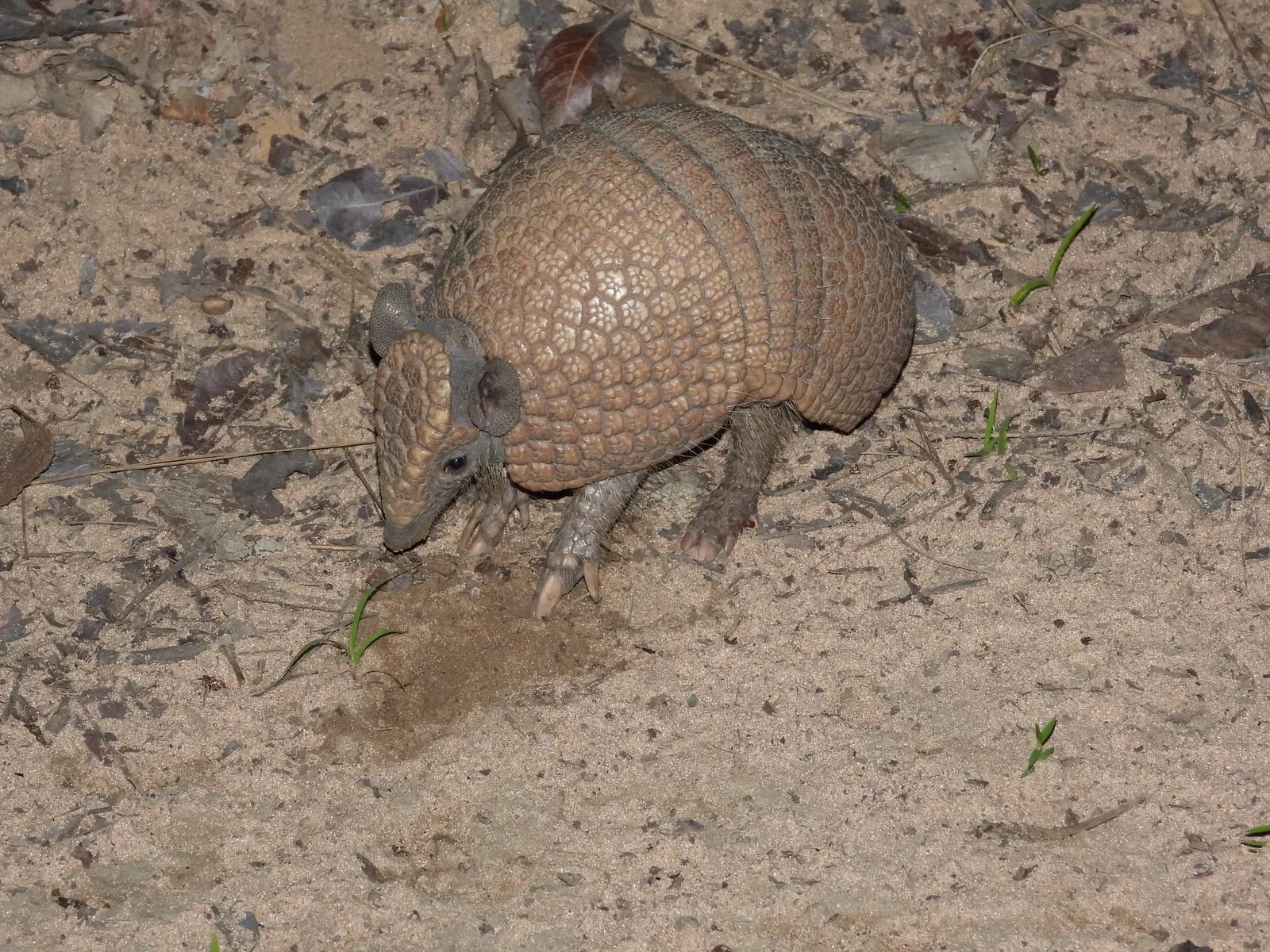
Brazilian three-banded armadillo
Tolypeutes tricinctus
Mammals — Cingulata (Dasypodidae)
The Brazilian three-banded armadillo is one of Brazil’s most distinctive and threatened mammals. Endemic to the country, it represents an extreme adaptation to life in dry, seasonal environments and symbolizes the contemporary challenge of conserving Brazilian wildlife.
Endemic to the Caatinga — Brazil’s dry thorn-scrub biome — and the northern Cerrado — the Brazilian savanna
With a defense unique among armadillos, the Brazilian three-banded armadillo can curl up completely, forming a rigid sphere. This evolutionary strategy, effective against natural predators, proves insufficient in the face of accelerating habitat loss.
📍 Biomes it inhabits
It occurs exclusively in Brazil, with a range restricted to the Caatinga and transition zones with the Cerrado, especially in the Northeast and north-central portions of the country. Its distribution is fragmented, with isolated populations.
🌍 Conservation status (IUCN)
VU · VulnerableAccording to the IUCN, the species is classified as VU • Vulnerable. Hunting, habitat loss, and low population density are its principal current threats.
🔬 Scientific classification
- Kingdom
- Animalia
- Phylum
- Chordata
- Class
- Mammalia
- Order
- Cingulata
- Family
- Dasypodidae
- Genus
- Tolypeutes
- Species
- Tolypeutes tricinctus (Linnaeus, 1758)
⚙️ Specifications and metrics
- Body mass: 1.0–1.6 kg (2.2–3.5 lb).
- Body length: 25–30 cm (9.8–11.8 in).
- Carapace: Composed of three movable bands, allowing it to curl up completely.
- Claws: Powerful forelimbs, adapted for foraging and digging.
- Metabolism: Low, consistent with environments where resources are limited.
- Generation length: Estimated at ~8–10 years — slow population recovery.
Diet: Insectivorous — ants, termites, and other soil invertebrates.
📅 Life cycle
- Gestation: Poorly documented; usually one offspring.
- Parental care: Maternal; the young remains protected within the territory.
- Behavior: Solitary and predominantly nocturnal.
- Lifespan: Estimated at 12–15 years in the wild.
🔗 Ecological ripple effect
By controlling populations of social insects, the Brazilian three-banded armadillo contributes to soil aeration and nutrient dynamics. Its protection entails conserving vast areas of the Caatinga, one of Brazil’s most neglected biomes.
🤔 Why it matters
- It is one of the few mammals able to close itself completely into a ball.
- It was considered possibly extinct for decades.
- It is endemic to Brazil.
- Its encounter rate in the wild is extremely low.
🧪 Did you know?
- It was rediscovered in 1988 after decades without confirmed records.
- It became a national symbol of conservation during major sporting events.
- The name Tolypeutes tricinctus refers to the ‘three movable bands’ of its carapace.
- The Caatinga is home to a large number of endemic and threatened species.
Small discoveries
- Curl up completely
- A defensive behavior in which the animal closes itself completely, protecting its soft parts.
- IUCN
- International Union for Conservation of Nature — the global authority on assessing extinction risk.
- Complete curling
- The unique ability to close the body completely into a ball.