.webp&w=1920&q=82)
.webp&w=1920&q=82)
.webp&w=1920&q=82)
.webp&w=1920&q=82)
Brown-backed Parrotlet
Touit melanonotus
Birds — Psittaciformes (Psittacidae)
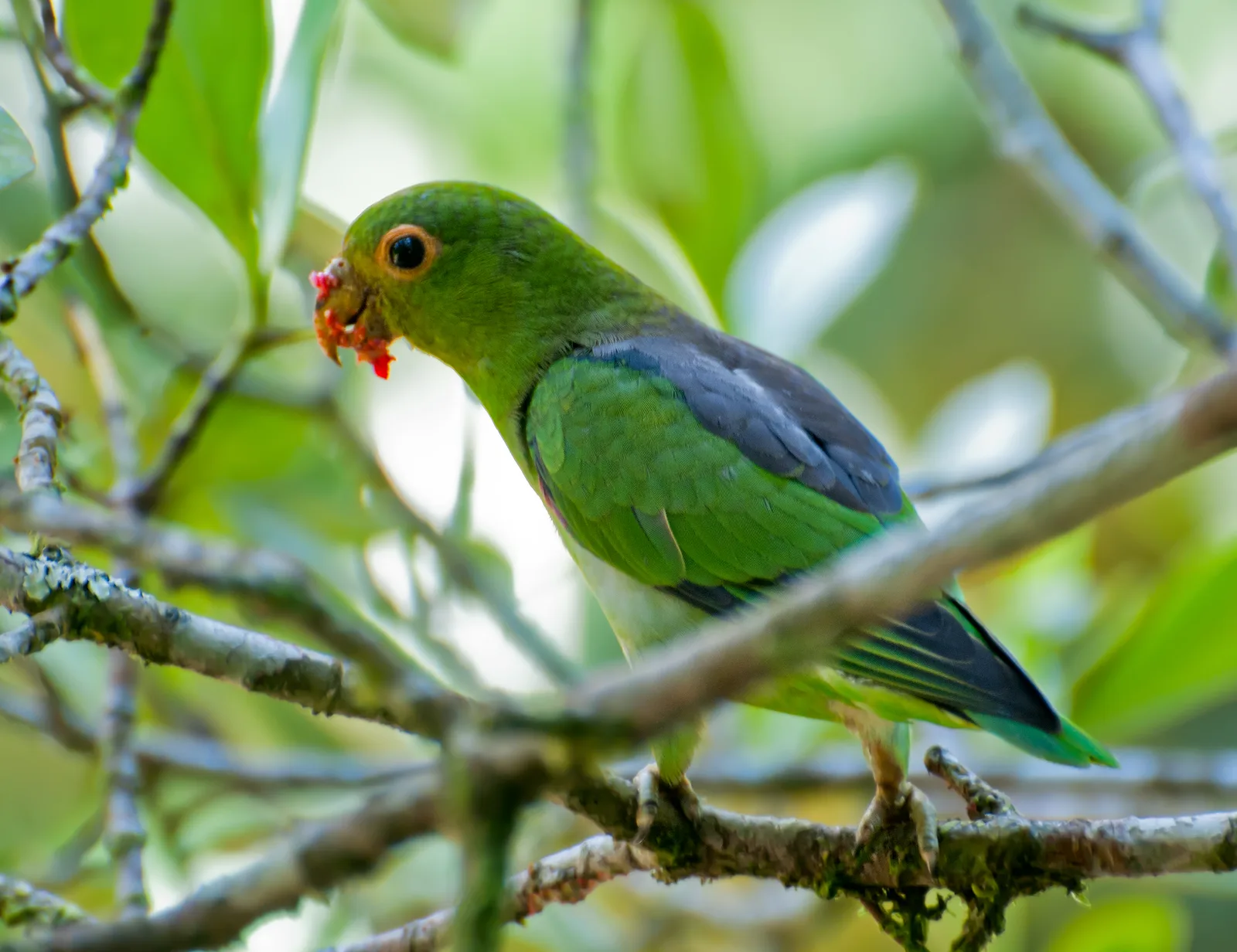
A green flash crosses the Atlantic Forest canopy, followed by a tiriri call that gives the flock away before the forest falls silent again. This is the Brown-backed Parrotlet, a small parrot endemic to Brazil: hard to see, hard to study, and impossible to mistake once its dark back and red tail appear in flight.
The elusive little canopy parrot still sheltered by the Atlantic Forest.
Touit melanonotus, the Brown-backed Parrotlet, occurs naturally only in Brazil: it is endemic to the Atlantic Forest. Small though it is, it moves in flocks and can cross the treetops swiftly, almost always easier to hear than see. Perched, however, it adopts another strategy: it retreats into dense foliage, where the green of its plumage dissolves into the canopy and the charcoal-gray back stops being a clue and becomes a secret.
📍 Biomes it inhabits
The species belongs to the Atlantic Forest and has a discontinuous distribution across its humid forests. Records range from coastal lowlands to montane forests; in different regions, it uses both the closed canopy and hillside formations. Observations along the coast of Paraná underscore the value of dense ombrophilous lowland forests, a forest type under intense human pressure. Movements between elevations have been suggested, possibly tracking fruiting trees, but still require confirmation through sustained study.
🌍 Conservation status (IUCN)
NT · Near ThreatenedOn the global IUCN Red List, the Brown-backed Parrotlet is classified as Near Threatened, with a declining population trend. The Brazilian assessment published by ICMBio in 2018 listed it as Vulnerable. The loss and fragmentation of the Atlantic Forest, especially its lowland forests, shrink and isolate the habitat on which it depends; urban expansion, agriculture, and infrastructure projects are among the documented pressures. Protecting forest remnants, maintaining connections between them, and expanding monitoring are decisive measures for a bird so elusive that much of its natural history remains hidden.
🔬 Scientific classification
- Kingdom
- Animalia
- Phylum
- Chordata
- Class
- Aves
- Order
- Psittaciformes
- Family
- Psittacidae
- Genus
- Touit
- Species
- Touit melanonotus (Wied-Neuwied, 1820)
⚙️ Specifications and metrics
- Length: About 15 cm (6 in).
- Body mass: No consolidated body-mass figure appears in the species-specific sources consulted.
- Plumage: Predominantly green, with a charcoal-gray mantle, back, and center of the rump; the chin may bear a small yellowish patch, and the outer tail feathers are red, marked by a broad black band. Tones vary among individuals, with no apparent sexual dimorphism.
- Vocalization: In flight, it usually gives a short, loud, resonant tiriri call. When perched, it is more discreet and may exchange low murmurs; under stress or aggression, it gives a harsh squawk.
Diet: It feeds on fruits and seeds, but its diet remains poorly known. In Ubatuba, it was observed opening unripe fruits of Clusia criuva with its bill and tongue, without using its feet to hold them; in Paraná, it has been recorded feeding on fruits of Struthanthus vulgaris. Fruiting trees appear to influence its local movements, but seasonal variation in its diet has yet to be clarified.
📅 Life cycle
- Reproduction: Poorly known. Young have been observed receiving regurgitated pulp from adults; breeding is considered likely from September, at the start of the rainy season, but field studies describing it are lacking.
- Nest: No reliable nest description appears in the species-specific sources consulted.
- Incubation: The incubation period has not been reliably documented for the species.
- Lifespan: No consolidated estimate of wild longevity appears in the species-specific sources consulted.
🔗 Ecological ripple effect
The Brown-backed Parrotlet’s ecological role is not yet known in detail, and that gap is part of the problem: a rarely seen species can vanish before everything it did is understood. By exploring fruits and seeds in the canopy, it is part of the web of relationships between fruiting trees and forest birds. Its loss would thin that web and also signal forests that are more fragmented, with less refuge and continuity for wildlife moving through the canopy.
🤔 Why it matters
- It is endemic to Brazil, placing responsibility for conserving the entire species on the country.
- It is an Atlantic Forest bird whose presence depends on preserved forests, especially lowland and hillside remnants.
- Its natural history remains incomplete; every record of feeding, voice, and movement strengthens the scientific basis for protecting it.
- A review of a vocalization attributed to the species in Paraná showed why spectrogram analysis is essential to reliable records.
- Its way of opening fruit with bill and tongue, without holding it with its feet, reveals an unusual feeding behavior among Neotropical parrots.
🧪 Did you know?
- A study of museum specimens identified three main plumage patterns in the species but found no apparent sexual dimorphism.
- In flight, its best-known call is a brief, resonant tiriri; at rest, the bird can remain almost silent in the canopy.
- In Ubatuba, individuals were seen opening fruits of Clusia criuva with their bills and tongues, without using their feet to hold them.
- Flocks of 6 to 70 individuals have been documented, yet perched groups can go unnoticed in dense foliage.
- A recording once used to confirm the species in Paraná was reassessed and identified as the voice of another bird, the Red-browed Amazon; recognizing its call therefore requires care.
Small discoveries
- Endemic
- Occurring naturally only within a defined geographic area.
- Canopy
- The upper layer of the forest, formed by the branches and leaves of trees.
- Mantle
- The upper part of a bird’s back, between the nape and the back.
- Dense Ombrophilous Forest
- A humid forest formation with closed vegetation and associated with abundant water availability.
- Spectrogram
- A visual representation of sound that shows its frequencies over time.
- Regurgitation
- The return of food from the crop or stomach to the mouth, used by birds to feed another individual.
📚 References
- IUCN Red List — Touit melanonotus
- ICMBio — Livro Vermelho da Fauna Brasileira Ameaçada de Extinção, volume III: Aves
- Vallejos et al. (2013) — Ocorrência e conservação de Touit melanonotus no sul do Brasil
- Simpson e Simpson (2012) — Behavioural notes on Brown-backed Parrotlet Touit melanonotus in Ubatuba, São Paulo, Brazil
- Carcassola et al. (2023) — Plumage Variation and Sex Ratio in the Brown-Backed Parrotlet
- Collar et al. (2020) — Brown-backed Parrotlet, Birds of the World
- GBIF — Touit melanonotus