.webp&w=1920&q=82)
.webp&w=1920&q=82)
.webp&w=1920&q=82)
.webp&w=1920&q=82)
Golden-tailed Parrotlet
Touit surdus
Birds — Psittaciformes (Psittacidae)
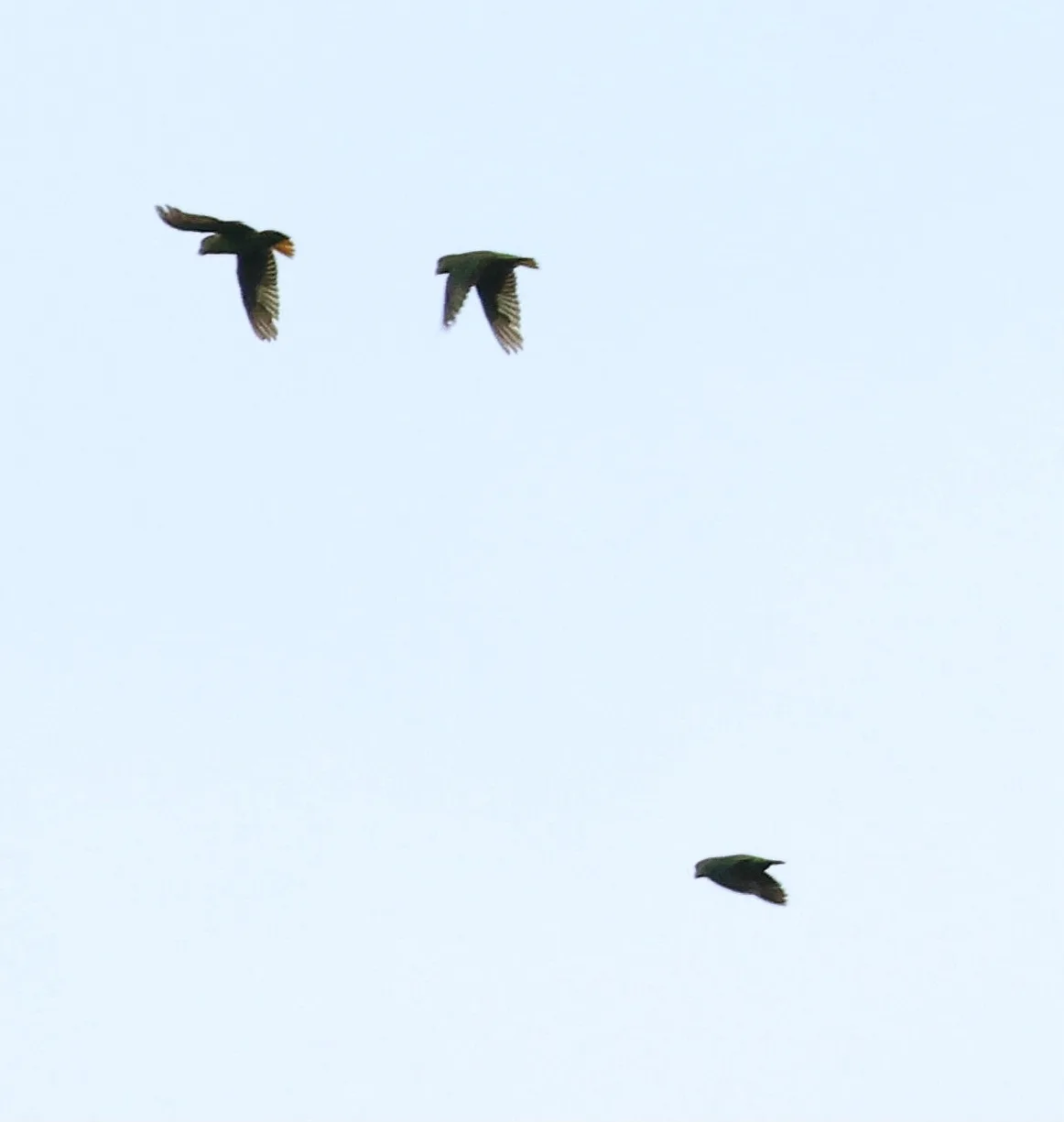
In the Atlantic Forest canopy, the Golden-tailed Parrotlet can vanish among leaves and branches when perched. In swift flight, however, its high voice and golden tail give it away. It is a bird endemic to Brazil: it lives naturally nowhere else.
A small Brazilian parrotlet whose flight, voice, and color become signals of the Atlantic Forest.
Touit surdus is a small parrotlet with a bright green body, a short, squared tail, and golden details that account for its common name. Rare and discreet, it is more often detected by the call it gives in flight than by its presence when perched. Sexual dimorphism in the lateral tail feathers helps distinguish the sexes: they are orange in males and green in females.
📍 Biomes it inhabits
The Golden-tailed Parrotlet is endemic to Brazil and tied to the Atlantic Forest of the country’s east. It lives in humid lowland and lower-montane forests, using chiefly the canopy, the upper layer formed by treetops. In the southern part of its range, it has been recorded up to 1,000 m (3,280 ft) in elevation. In some areas, it may make seasonal movements, possibly following shifts in resource availability.
🌍 Conservation status (IUCN)
VU · VulnerableThe IUCN Red List, in an assessment made available by BirdLife International, classifies the species as Vulnerable. Its rationale cites a small, declining population in the face of continued deforestation. For a rare bird dependent on humid forests, protecting Atlantic Forest remnants and maintaining their connectivity are decisive.
🔬 Scientific classification
- Kingdom
- Animalia
- Phylum
- Chordata
- Class
- Aves
- Order
- Psittaciformes
- Family
- Psittacidae
- Genus
- Touit
- Species
- Touit surdus (Kuhl, 1820)
⚙️ Specifications and metrics
- Length: About 16 cm (6.3 in).
- Body mass: No species-specific range was found that was consistently documented in the reference sources consulted.
- Plumage: Bright green predominates; the face and cheeks have yellowish areas, the crown and neck look scaled, and brownish scapulars form two bands on the back. The short, squared tail is golden yellow with black tips and green central tail feathers. In males, the lateral tail feathers are orange; in females, green.
- Vocalization: It gives high-pitched flight calls with a falsetto quality. It is usually silent when perched and becomes more vocal in flight.
Diet: The Golden-tailed Parrotlet’s diet remains poorly known. Published records point to fruit consumption, including unripe fruits of Spondias lutea and ripe fruits of Rapanea schwackeana. There is still not enough information to safely describe seasonal variation in its diet; seasonal movements, however, may occur across part of its range.
📅 Life cycle
- Reproduction: The species’ reproductive biology is very poorly known.
- Nest: There are records of nests inside arboreal termite nests, high in trees.
- Incubation: The incubation period is not well documented for the species in the open reference sources consulted.
- Lifespan: No species-specific, sufficiently documented estimate of longevity appears in the reference sources consulted.
🔗 Ecological ripple effect
No study has yet quantified the ecological effect of losing the Golden-tailed Parrotlet. The species is known to eat fruits; its disappearance would therefore remove a fruit-eating bird from the canopy and reduce the diversity of interactions between birds and plants. In landscapes already fragmented, the loss of a rare forest species also signals an impoverishment of the bird community and its functions.
🤔 Why it matters
- It is a species endemic to Brazil, so its conservation depends entirely on decisions made in the country.
- It is part of the threatened birdlife of the Atlantic Forest and illustrates the cost of losing and fragmenting humid forests.
- By eating fruits, it takes part in the network of relationships between canopy birds and plants, although its specific contribution still needs to be measured.
- Its rarity, elusive habits, and the gaps in knowledge of its reproduction make it a priority for research and monitoring.
- Photographic and audio records help make visible a bird that often goes unnoticed when perched.
🧪 Did you know?
- When perched, the Golden-tailed Parrotlet tends to remain silent; in flight, it becomes more vocal.
- The species has a short, squared, golden-yellow tail with black tips; the central tail feathers are green.
- In males, the lateral tail feathers are orange; in females, green.
- There are records of nests inside arboreal termite nests, a valuable clue in a reproductive history still little known.
- Though it is a parrot, it measures about 16 cm (6.3 in): it is one of the smaller birds among Brazil’s psittacids.
Small discoveries
- Canopy
- The upper layer of the forest formed by the treetops.
- Tail feathers
- Tail feathers that aid flight and steering.
- Arboreal termite nest
- A termite nest built on trees.
- Endemic
- Occurring naturally only within a defined geographic area.