.webp&w=1920&q=82)
.webp&w=1920&q=82)
.webp&w=1920&q=82)
.webp&w=1920&q=82)
Southern Lapwing
Vanellus chilensis
Birds — Charadriiformes (Charadriidae)
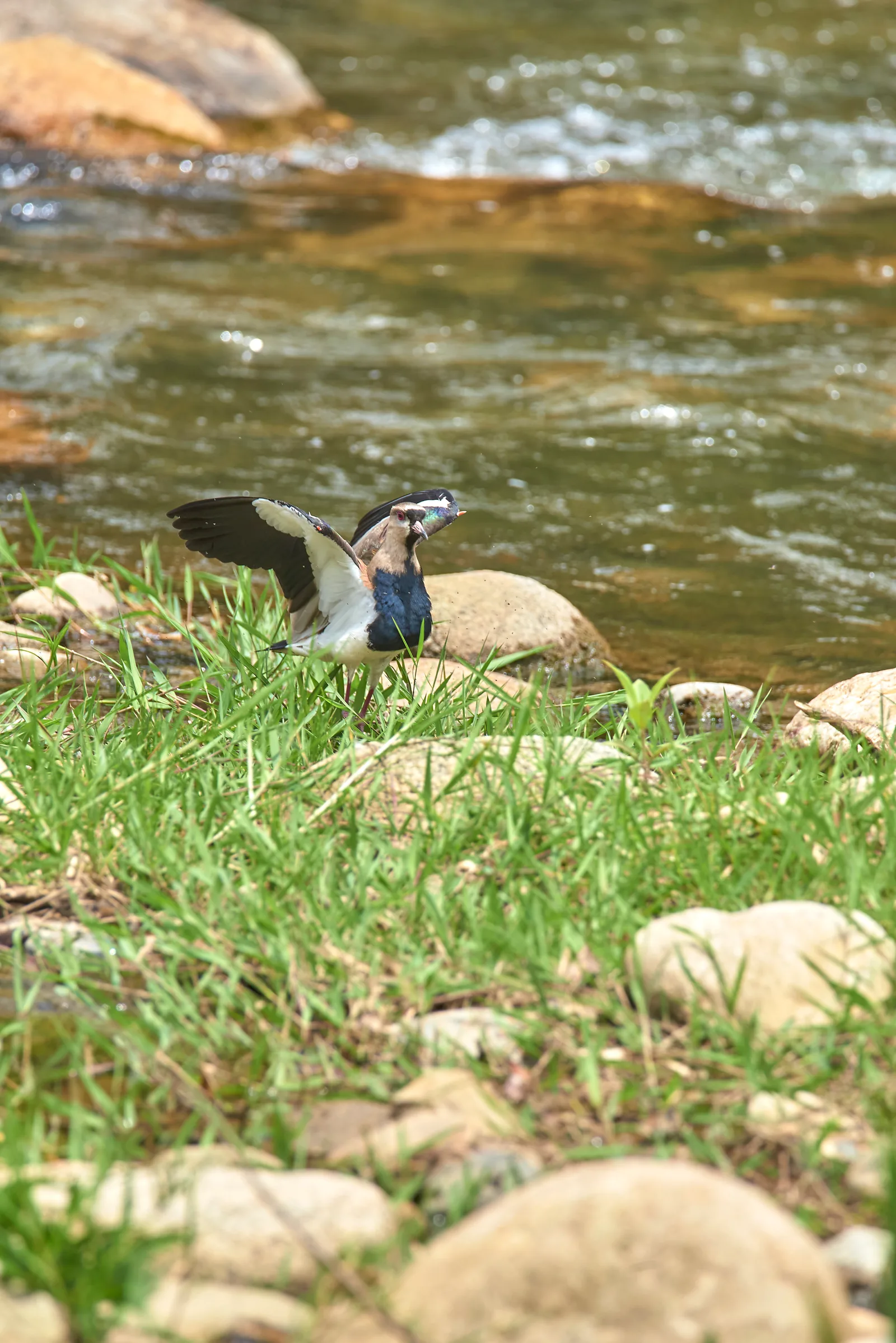
Before anyone sees a Southern Lapwing, it is often heard: its loud call slices across the field, announcing that a sentinel is on duty. With crest raised, breast boldly marked in black, and spurs concealed in its wings, this bird turns an open expanse into guarded territory.
The audible alarm of South American grasslands.
The Southern Lapwing is a charadriid of open environments, widely distributed from northern South America to Tierra del Fuego, and also found in Panama. In Brazil, it is familiar on lawns, grasslands, pastures, water margins, and even in urban landscapes. Its elegant appearance can mislead: during the breeding season, its life revolves around an inconspicuous nest on the ground and an insistent defense against anyone who comes near.
📍 Biomes it inhabits
The species occurs in all six Brazilian biomes, but it does not use each in the same way. It seeks clearings, grasslands, pastures, várzeas — seasonally flooded Amazonian forests —, the edges of bodies of water, and human-altered areas with low vegetation, including regions where a more open landscape favors its expansion. Studies in southern Brazil show an affinity for impacted grasslands and human-influenced open areas, while also revealing an aversion to forested tracts and taller shrubby vegetation.
🌍 Conservation status (IUCN)
LC · Least ConcernGlobally, Vanellus chilensis is classified as Least Concern by the IUCN Red List, consistent with its broad distribution and frequent presence in open landscapes. That does not eliminate local concerns: because it nests on the ground, the species may be affected by disturbance near nests, intense trampling, and unsuitable management of open areas during breeding. Conserving grasslands is not simply a matter of keeping space free of trees; it requires mosaics of low vegetation and management that respects the season when eggs and chicks are vulnerable on the ground.
🔬 Scientific classification
- Kingdom
- Animalia
- Phylum
- Chordata
- Class
- Aves
- Order
- Charadriiformes
- Family
- Charadriidae
- Genus
- Vanellus
- Species
- Vanellus chilensis (Molina, 1782)
⚙️ Specifications and metrics
- Length: Between 35 and 37 cm (14–15 in) in total length.
- Body mass: Between 255 and 277 g (9–10 oz).
- Plumage: Gray-brown back with a bronze sheen, black head and breast band, white belly, crest, and spurs on the wings.
- Vocalization: Loud, harsh, repeated calls used in alarm, defense, and territorial interactions; one vocalization is associated exclusively with the breeding season.
Diet: Feeds chiefly on insects and other invertebrates, including aquatic forms; it may also capture small fish. It forages in open terrain, watches the ground, and lowers its bill to seize prey. In a behavioral study from southern Brazil, feeding was more frequent outside the breeding season, when defending nests and chicks had not yet come to dominate its time budget.
📅 Life cycle
- Reproduction: In Brazil, breeding generally takes place from August to December. At this time, individuals leave large flocks to form breeding pairs or trios; monogamy, polygamy, and cooperative breeding have been recorded in different populations.
- Nest: A simple, open depression directly on the ground, made with little material; the clutch may range from one to four eggs.
- Incubation: Adults share incubation at the exposed nest; it lasts about 26 days.
- Lifespan: No lifespan estimate is used in this profile.
🔗 Ecological ripple effect
If the Southern Lapwing disappeared from a grassland landscape, there would be one fewer consumer of insects, aquatic invertebrates, and small fish moving among soil, shallow water, and pasture. One of these environments' most visible interactions would also be lost: territorial defense that brings low flights, alarm calls, and constant vigilance around eggs and chicks. Its absence would not have a single isolated effect, but would weaken the web of relationships linking open grasslands, invertebrates, and ground-dwelling birds.
🤔 Why it matters
- Consumes invertebrates from the ground and shallow water, connecting these resources to the food chain of open environments.
- Its territorial behavior makes visible the breeding of birds that depend on exposed ground or low vegetation for nesting.
- It is important to research in ethology: a study in Rio Grande do Sul recorded 23 behaviors distributed across five categories and three types of vocalization.
- In Rio Grande do Sul, it is recognized as a symbolic bird and forms part of popular and traditionalist culture.
- Its presence in pastures, parks, and cities helps frame discussions about coexistence among wildlife, land management, and urban expansion.
🧪 Did you know?
- The Southern Lapwing can fly low and in circles over an intruder, with its wing spurs exposed; although the approach is forceful, physical contact is rare.
- When the eggs are at risk, an adult may position itself over them, spread its wings briefly, and call loudly.
- Chicks and juveniles respond to danger with a strategy opposite to the adults' alarm: they crouch on the ground, tuck away their legs, and draw in their necks to reduce visibility.
- Most populations are resident, but groups from the far south of the range move to warmer areas in winter.
- In southern Brazil, observers distinguished three forms of vocalization, differing in sound, duration, and context of use.
Small discoveries
- Human-altered
- An environment altered by human activities, such as grazing, farming, roads, or urban development.
- Charadriid
- A bird in the family Charadriidae, a group that includes plovers, lapwings, and related species.
- Ethology
- The branch of science dedicated to the study of animal behavior.
- Incubation
- The period during which eggs are kept warm and protected until they hatch.
📚 References
- BirdLife International. Southern Lapwing Vanellus chilensis Species Factsheet.
- Santos, E. S. A. 2020. Southern Lapwing Vanellus chilensis. Birds of the World.
- Delfino, H. C.; Carlos, C. J. 2020. O guardião dos campos: um estudo sobre o comportamento do quero-quero Vanellus chilensis no sul do Brasil.
- Delfino, H. C.; Carlos, C. J. 2021. Macro and micro-habitat selection by Vanellus chilensis in southern Brazil.
- Souza, L. S. et al. 2021. First record of helminths parasitizing Vanellus chilensis in Acre state, southwestern Brazilian Amazon.
- Quirici, V. et al. 2025. Feather corticosterone levels in the Southern Lapwing.
- GBIF — Vanellus chilensis