.webp&w=1920&q=82)
.webp&w=1920&q=82)
.webp&w=1920&q=82)
.webp&w=1920&q=82)
White-winged Cotinga
Xipholena atropurpurea
Birds — Passeriformes (Cotingidae)
When the male crosses a high clearing, white wings break against the green and leave a hum in the air that is not song: it is flight itself becoming a signal. The White-winged Cotinga is a bird endemic to Brazil, now dependent on the fragments that still uphold the Atlantic Forest between Paraíba and Rio de Janeiro.
Canopy brilliance and the sound of wings in a fractured Atlantic Forest.
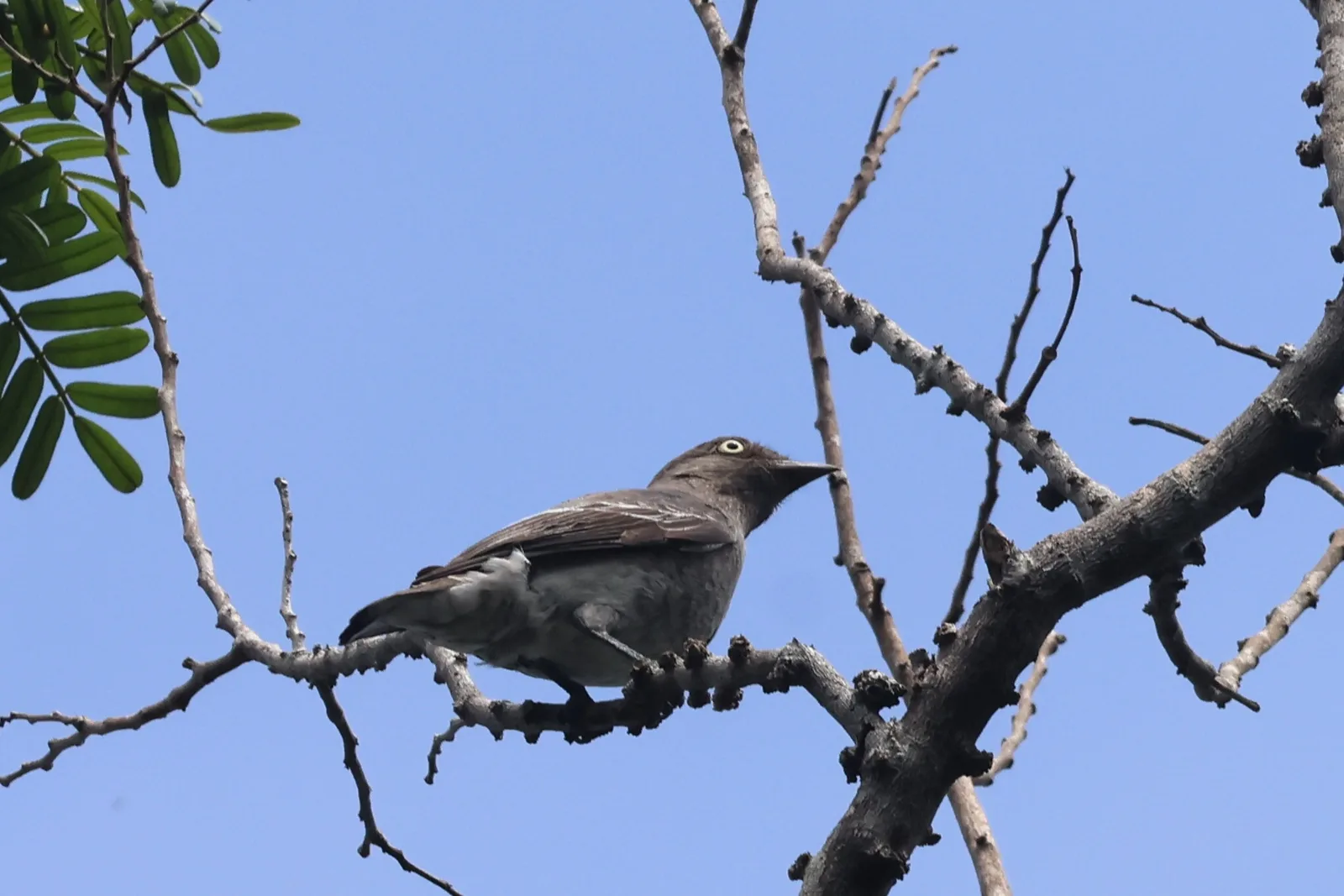
The White-winged Cotinga is a canopy bird, more often noticed by movement among exposed branches or the sound of its flight than by its closeness. The intense violet-black male with white wings stands in contrast to the gray female; that sexual dimorphism makes an encounter with each sex a distinct visual experience. Naturally restricted to Brazil, the species belongs to the Atlantic Forest's singular fauna and now occupies a highly fragmented range.
📍 Biomes it inhabits
This species is endemic to Brazil and occurs only in the Atlantic Forest, in coastal forests of the country's east from Paraíba to Rio de Janeiro. It favors moist, well-structured lowland forests, but has also been recorded in open rainforests, semideciduous forests, restinga — coastal sandbank vegetation — and some secondary remnants. The canopy is its realm for feeding and display; for that reason, continuity between crowns and the presence of fruiting trees matter as much as the fragment's area.
🌍 Conservation status (IUCN)
VU · VulnerableOn the IUCN Red List, the White-winged Cotinga is classified as Vulnerable, with a declining population trend. The assessment points to a small, severely fragmented range, along with continuing habitat destruction. Deforestation, illegal logging, fire, urban and agricultural expansion, and ineffective protection across part of its range confine the species to a few remaining patches; the situation is especially delicate in the Pernambuco Center of Endemism. Creating and connecting protected areas, retaining large trees, and monitoring populations and nests are decisive measures.
🔬 Scientific classification
- Kingdom
- Animalia
- Phylum
- Chordata
- Class
- Aves
- Order
- Passeriformes
- Family
- Cotingidae
- Genus
- Xipholena
- Species
- Xipholena atropurpurea (Wied-Neuwied, 1820)
⚙️ Specifications and metrics
- Length: About 19 cm (7.5 in).
- Body mass: Males: 58–65 g (2–2.3 oz); females: 56–67 g (2–2.4 oz).
- Plumage: The male is violet-black, with white wings and dark tips; the female is grayer and more subdued, with white edging on the wing feathers.
- Vocalization: Its call is a short chirp. In flight, it also produces a mechanical wing hum, audible in the rapid wingbeats.
Diet: It is chiefly frugivorous: it seeks fruiting trees in the canopy, perches on nearby branches, and swallows small fruits, often whole. Its diet changes with the local and seasonal availability of plants; fruits from many families have been recorded, with recent emphasis on Araliaceae and Malpighiaceae, while earlier studies documented Moraceae, Myrtaceae, and Lauraceae. It also eats flowers and, especially during the breeding season, adds insects to its diet, including lepidopteran larvae and orthopterans caught in flight.
📅 Life cycle
- Reproduction: Breeding activity appears to be concentrated between August and February. Males perform display flights among the canopy crowns, documented chiefly from November to February.
- Nest: The female builds a small cup high in a tree, in the fork of a branch; nests have been recorded 15–20 m (49–66 ft) above the ground, and some have been found in October and November.
- Incubation: Incubation has been recorded in October, but its duration has not been reliably documented for the species.
- Lifespan: No reliable published estimate of longevity is available for the species.
🔗 Ecological ripple effect
By swallowing whole fruits and moving through the canopy in search of productive trees, the White-winged Cotinga is part of a network linking fruiting plants, insects, and canopy birds. Removing a frugivore from an already fragmented landscape tends to weaken the movement of seeds between remnants and reduce the resilience of a forest that depends on many dispersers. Its absence would also be a symptom: more than the loss of a striking bird, it would show that the canopy no longer offers enough food, structure, and connection for specialized fauna.
🤔 Why it matters
- It is endemic to Brazil and exclusive to the Atlantic Forest, making the conservation of its remnants a national responsibility.
- Its occurrence is concentrated in a few forest fragments and protected areas, helping reveal where the Atlantic Forest still sustains conditions for canopy birds.
- As a frugivore that swallows fruits whole, it is part of the web of interactions between fruiting trees and seed-dispersing wildlife.
- Its pronounced sexual dimorphism and wing hum make it one of the most distinctive cotingas in Brazil's avifauna.
- Recent records in the Northeast show that important knowledge gaps remain and underscore the value of citizen science combined with field monitoring.
🧪 Did you know?
- The sound of its wings is no mere background noise: rapid wingbeats produce a mechanical hum audible in flight.
- Males and females look like very different birds: the male wears violet-black and white; the female, gray and muted tones.
- No migratory movements are known for the species; it is observed foraging in trees that are bearing fruit.
- A study published in 2026 recorded the species in Paraíba again after nearly ten years without records in the state.
- The fruits it eats are usually small and may be swallowed whole; its diet changes with the flora available in each region.
Small discoveries
- Canopy
- The upper layer of a forest, formed by the crowns of its trees.
- Frugivore
- An animal whose diet consists mainly of fruits.
- Rainforest
- A forest associated with high humidity and frequent rainfall.
- Fragmentation
- The division of a continuous environment into smaller, isolated areas.
- Endemic
- A species that occurs naturally only within a defined geographic area.
📚 References
- IUCN Red List — Xipholena atropurpurea
- ICMBio — Livro Vermelho da Fauna Brasileira Ameaçada de Extinção, volume III: Aves
- Martins et al. (2026) — Occurrence and diet of the threatened White-winged Cotinga Xipholena atropurpurea in the northern Atlantic Forest, Brazil
- eBird/Merlin — anambé-de-asa-branca
- WikiAves — anambé-de-asa-branca
- Birds of the World — White-winged Cotinga
- GBIF — Xipholena atropurpurea