Brazilian vegetation · plant formation
Steppe Savanna (Savana-Estépica)
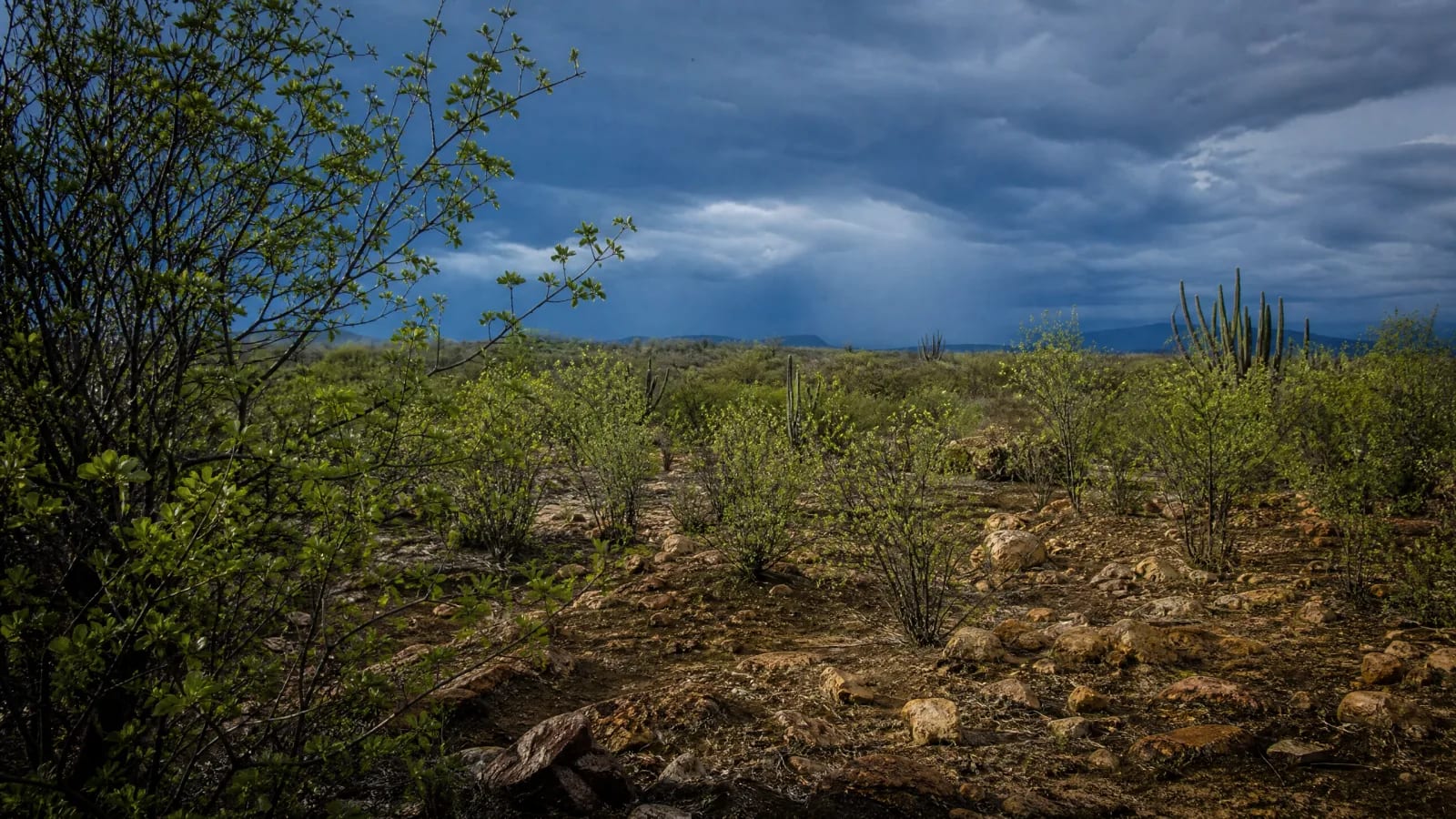
The landscape seems to keep the rain inside the stones. Low shrubs, grasses, and cacti draw an open architecture made to endure heat, wind, and long intervals between one rainfall and the next. Here, dryness is not emptiness: it is a language of reduced leaves, spines, patient roots, and small shadows. 1
The shape of the landscape matters.
Chegue pela luz dura das baixadas e dos lajedos. O horizonte se mantém largo, mas o olhar precisa descer: uma casca fissurada, um fruto protegido, a crosta do solo, o leito que espera. A Steppe Savanna (Savana-Estépica) aparece sobretudo no Semiárido nordestino, embora também surja em ocorrências disjuntas, como Roraima, o Chaco sul-mato-grossense e o extremo sul do país. 2
I · Recognition
Before becoming a backdrop, it is already life.
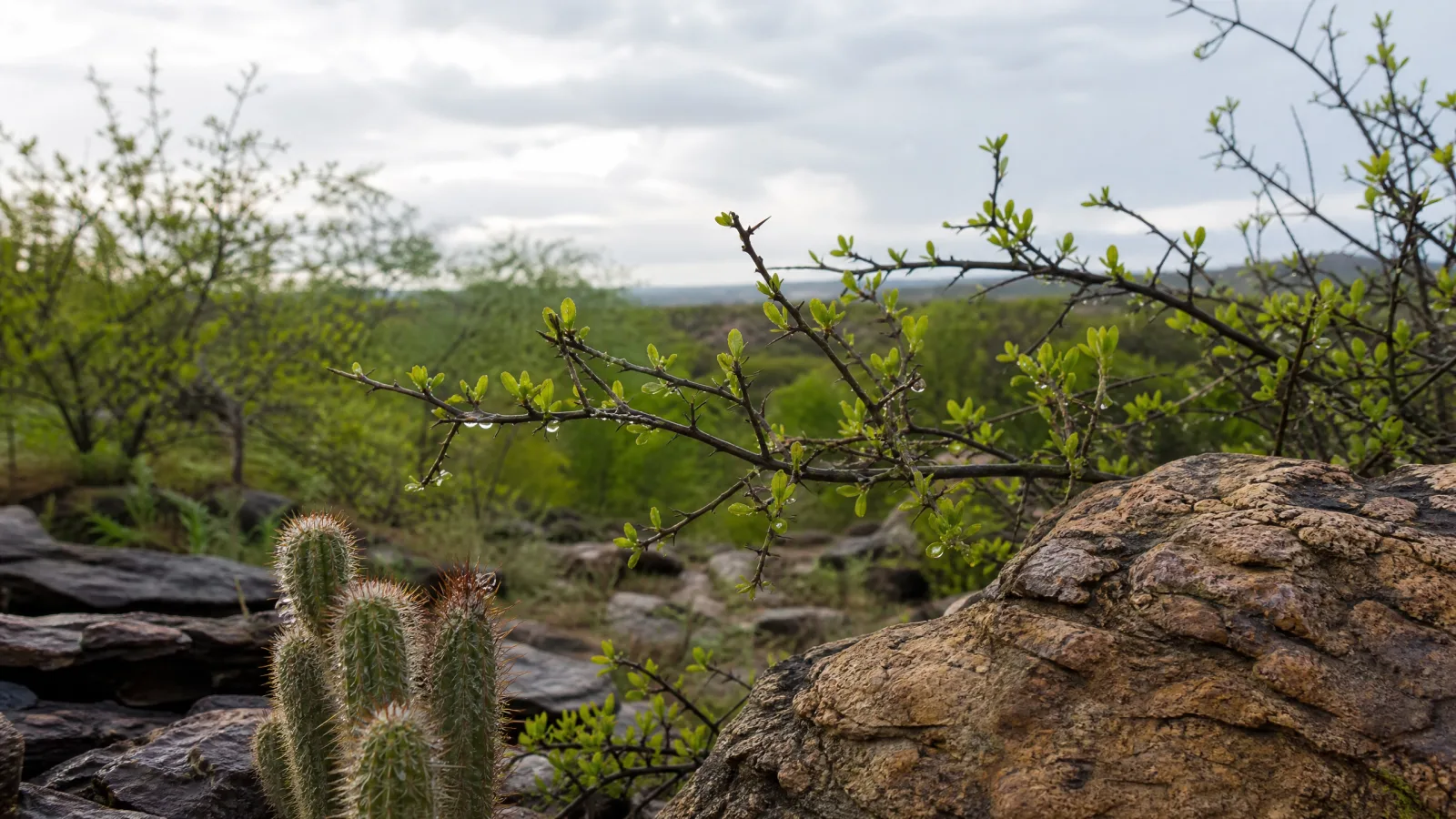
The name encompasses more than one appearance. Phytoecological classification recognizes forested, wooded, parkland, and grassy-woody physiognomies; among them, height, density, and the proportion of woody plants, grasses, and cacti vary. The vegetation popularly called Caatinga is one of its best-known expressions, but it does not exhaust the term. 2
II · Water and rhythm
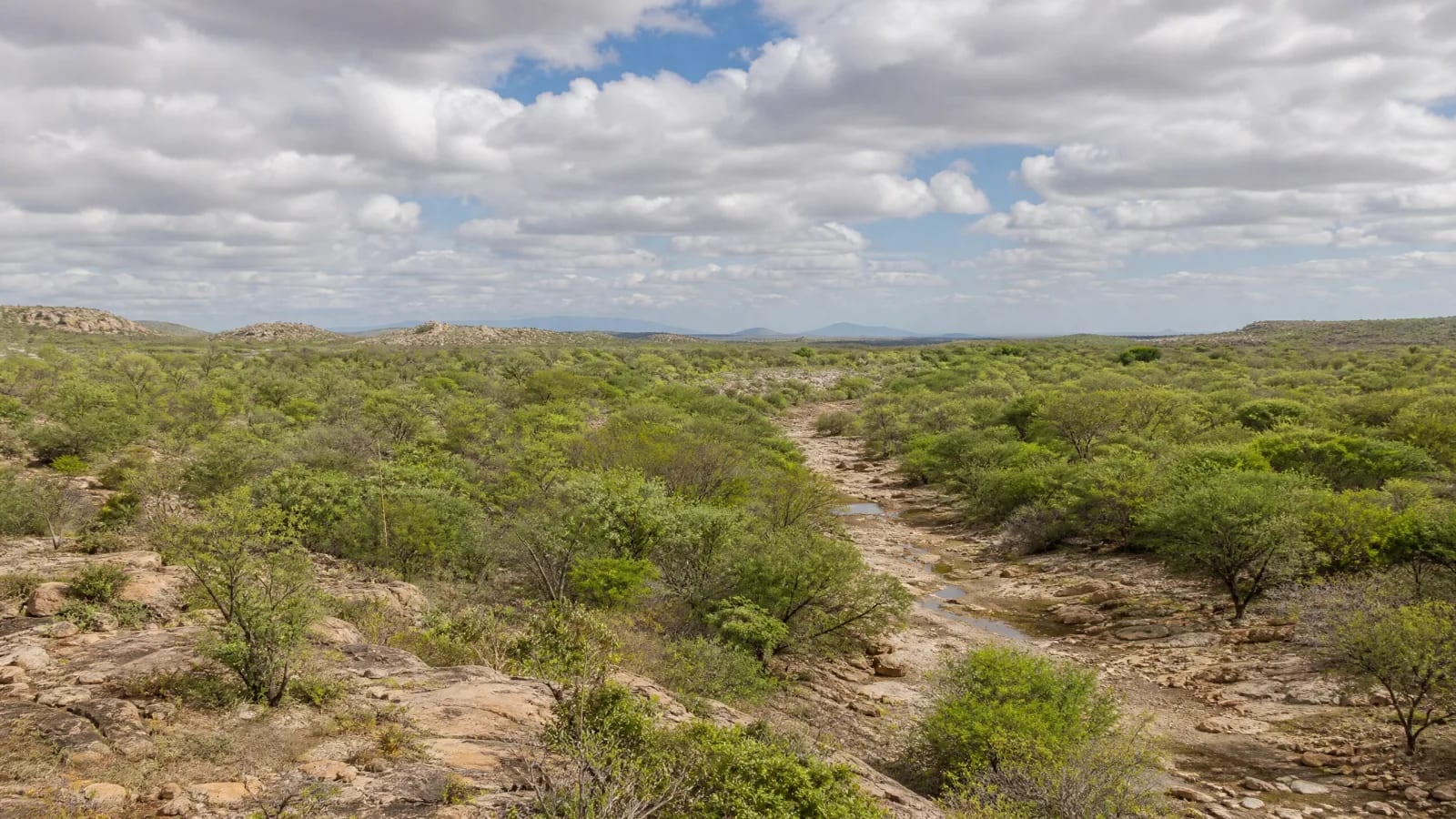
Water arrives irregularly in time and space, and the landscape responds to every detail of the relief. Shallow, stony, or solodic soils retain possibilities different from those of deeper areas; in the Middle São Francisco, the association between lowered surfaces and solodic, shallow soils helps explain a stress that cannot be seen only in the sky. 3
III · Work and territory
No formation exists outside human choices.
Agriculture, animal husbandry, and extractivism take place within this economy of uncertainty. Use depends on the site: a flat, deeper area does not offer the same future as a stony slope or saline ground. The question is not whether the territory is used, but how vegetation cover, water, and income remain possible after use.
Some choices belong to the scale of management: conserve cover, adjust stocking rates, protect banks and slopes, reduce soil exposure, and restore fragile stretches. Embrapa describes thinning, lowering, and enrichment technologies associated with conservative pasture management; the technique makes sense only when it respects the place and its capacity for regeneration. 4
IV · The connection we forget
The territory remains present after the product leaves the scene.
On a Semi-Arid property, removing firewood or grazing may meet an immediate need; if cover does not recover, the sequence may be exposed soil, erosion, siltation, and reduced productive capacity. The case does not justify blaming a community or casting animal husbandry as the villain: what rules, scale, and technical support make it possible to use the land without pushing the landscape toward degradation that is harder to reverse? 4 5
Read pressure as a chain, not a label. Observe what was removed, for how long, with what intensity, and what remains connected. Record the rain that came, the water that ran off, the plant that returned, and the area that did not. An image of bare ground may be a moment; investigation begins when one asks about its duration.
V · Precision
Critique is valid only when it respects the evidence.
Steppe Savanna (Savana-Estépica) não é sinônimo absoluto de todo o bioma Caatinga, assim como “seca” não descreve sozinha seus solos, seus seres e seus usos. A classificação é uma ferramenta de leitura; o território sempre pede escala, estação e história local.
To look at this formation is also to learn not to simplify it.
When the rain returns, the response may be swift, but it does not erase what happened between the drops. The beauty lies precisely in this negotiation: a life that flourishes with little, and that needs care so that the little may continue to arrive.
📚 References
- 1.IBGE — Conhecendo os tipos de vegetação do Brasil
- 2.Embrapa — Classificação e aspectos da vegetação brasileira
- 3.SciELO — Savana-Estépica e solos no Médio São Francisco
- 4.Embrapa — Manipulação da vegetação da Caatinga para produção sustentável de forragem
- 5.Embrapa — Solos do bioma Caatinga
- 6.Embrapa — Água no bioma Caatinga
- 7.SciELO — Manejo da Caatinga para produção de caprinos e ovinos