.webp&w=1920&q=82)
.webp&w=1920&q=82)
.webp&w=1920&q=82)
.webp&w=1920&q=82)
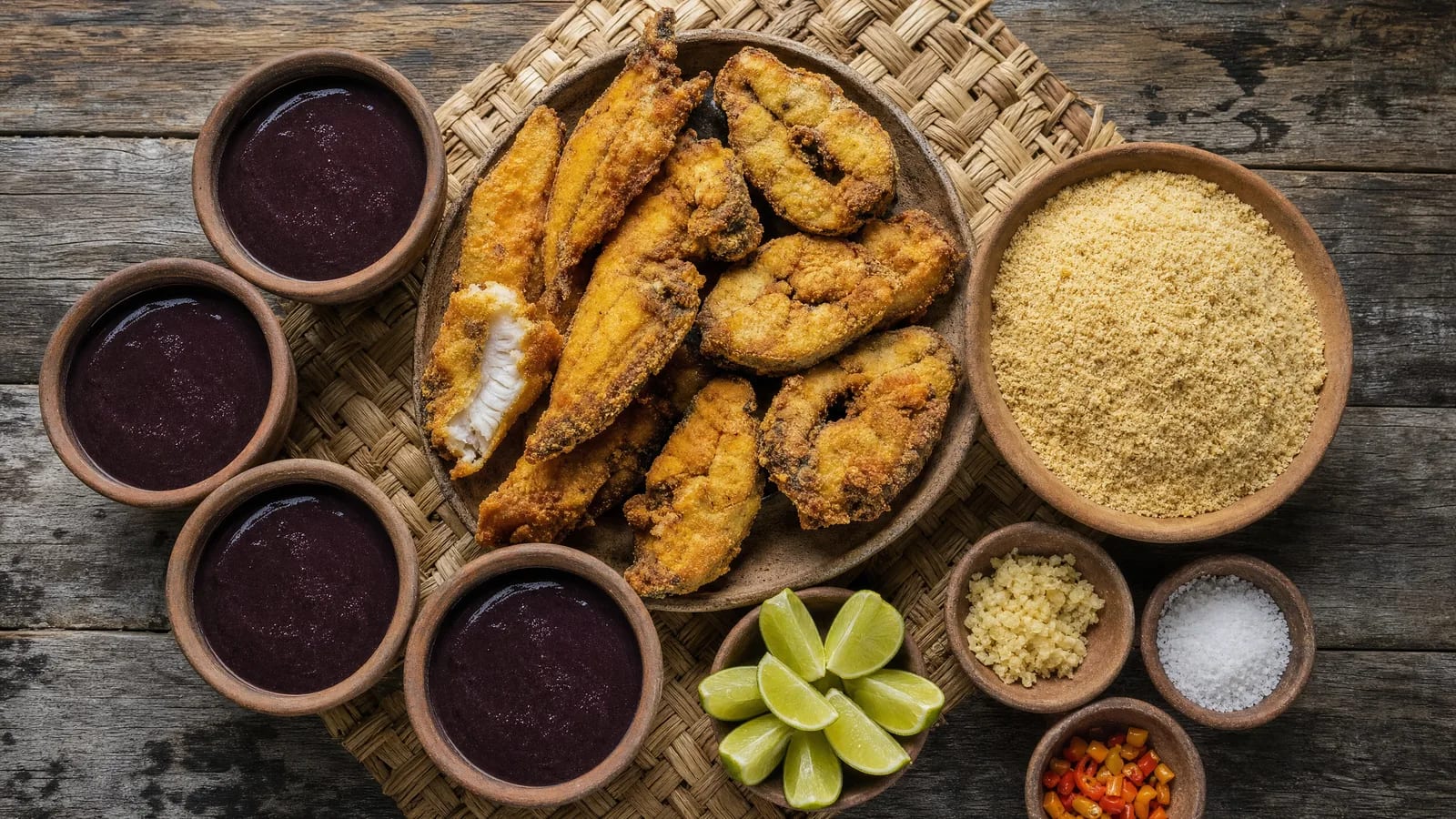
Unsweetened vinho de açaí—the thick blended pulp of the dark Amazonian palm berry—joins fried fish and farinha d’água in an everyday meal at the mouth of the Amazon. It is an Amazonian tradition shared with Pará, presented here through Amapá’s table, where açaí is treated as savory food.
Behind the flavor
More than a fashionable ingredient, açaí is everyday food for many Amazonian families. In Amapá it appears thick and unsweetened, served with cassava flour and fish: a pairing bound to riverside life and the pantry of the Amazon’s mouth. The meal is a shared Amazonian tradition, especially between Amapá and Pará, not an invention of the sweet bowl.
📜 Ingredients
- 🍷vinho de açaí (thick, unsweetened pulp)1 liter (4 cups), very fresh🔁 Frozen whole açaí pulp, without syrup or sugar — The texture may be less lively and less fresh, but it preserves the savory character of the dish.
- •acoupa weakfish, in fillets or steaks800 g (1 3/4 lb)🔁 Baby, sea bream or other firm-fleshed white fish — The frying is still good, but the flavor is different from that of fish from the Amazon mouth.
- •Lemon juice2 tablespoons
- •crushed garlic2 cloves
- •Salt1 teaspoon, or to taste
- 🌶️chopped pimenta-de-cheiro1 small unit, or to taste🔁 Finely diced yellow bell pepper — The fish is fragrant, but loses the mild and aromatic spiciness of the regional pepper.
- •Wheat flour1/2 cup, for light dredging
- •Vegetable oilenough to cover the pan bottom by about 1 cm (3/8 in)
- 🌾farinha d'água1 1/2 cups, for serving🔁 Coarse roasted cassava flour — The substitute accompanies the fish, but lacks the graininess and mild acidity characteristic of farinha d'água.
- •Lemon in wedges1 unit, to serve
👨🍳 Method
- 1
If the vinho de açaí is very thick, stir it with a clean spoon until smooth, without sweetening it. Keep refrigerated while you prepare the fish.
Use açaí that is suitable for consumption, from a safe source and kept under refrigeration; the sweetened version for bowls doesn't deliver on the flavor of this meal.
- 2
Season the acoupa weakfish with lemon juice, garlic, salt and pimenta-de-cheiro. Let rest for 10 min, then pat the surface dry with paper towel.
The pepper should be fragrant, not overpowering: add more at the table, if desired.
- 3
Dredge the fish lightly in wheat flour and shake off the excess. Heat the oil over medium-high heat to about 170–180 °C (340–355 °F); a crumb of flour should bubble without darkening at once.
The light breading forms a crust without hiding the fish meat.
- 4
Fry the acoupa weakfish in batches for 3–5 min per side, depending on thickness, until golden and opaque at the center. Drain on paper towel and keep warm while you finish the remaining batches.
Don't crowd the pan: cold oil makes the fish greasy and prevents it from browning.
- 5
Serve the vinho de açaí unsweetened in deep bowls. Set out the fried fish, farinha d’água and lemon wedges separately so each person can build a spoonful in the riverside manner.
The tradition is one of contrast: cold açaí, hot fish and crunchy flour.
🥃 Pairing
With cachaça
White/silver
Vegetable, citrusy and with a clean finish, served very cold
The lightness refreshes the frying and does not compete with the earthy bitterness of unsweetened açaí. As Amapá is not a traditional producer of cachaça, choose a still distillate from another state.
Also pairs well with
✈️ A flavor worth the trip
In Macapá, order unsweetened açaí from a trusted açaí stand and taste it plain before mixing in the farinha d’água. That earthy acidity is the key to understanding why fried fish belongs so naturally in the bowl.
💡 Quick tips
- •Never add granola, condensed milk or banana: this is a savory açaí dish.
- •Choose whole açaí pulp, without sugar, dyes or syrups.
- •Fry the fish just before serving to preserve the crust against the moisture from the açaí.
- •For a heartier table, also serve dried shrimp or fried plantains, without changing the base of the dish.
🤔 Did you know?
The name vinho de açaí does not mean an alcoholic drink: in the Amazon, it refers to the fruit’s thick blended pulp, eaten as food and often accompanied by flour and fish.
Small discoveries
- Vinho de açaí · ingredient
- Amazonian name for the thick pulp of açaí blended, with no necessary connection to alcohol.
- Pescada amarela · ingredient
- Fish with light and firm flesh, common in markets along the coast and at the mouth of the Amazon.
- Farinha d'água · ingredient
- Cassava flour, granulated and slightly fermented in water before roasting, essential on the Amazonian table.
- Ribeirinha · cultural expression
- Relative to populations living on the banks of Amazon rivers, in daily dialogue with fishing, farming and circulation through water.
📚 References
- Empresa Brasileira de Pesquisa Agropecuária (Embrapa Amazônia Oriental). Chemical composition and seasonal variations in açaí as it is consumed in the Brazilian Amazon. https://www.embrapa.br/en/busca-de-publicacoes/-/publicacao/1163643/chemical-composition-and-seasonal-variations-in-acai-as-it-is-consumed-in-the-brazilian-amazon
- FARIAS, R. T. S.; BRITO, D. M. C. O açaí no contexto do território e da territorialidade ribeirinha na Amazônia brasileira. Confins, 2022. https://journals.openedition.org/confins/44303
- CASCUDO, Luís da Câmara. História da Alimentação no Brasil. Global Editora.
Keep discovering