.webp&w=1920&q=82)
.webp&w=1920&q=82)
.webp&w=1920&q=82)
.webp&w=1920&q=82)
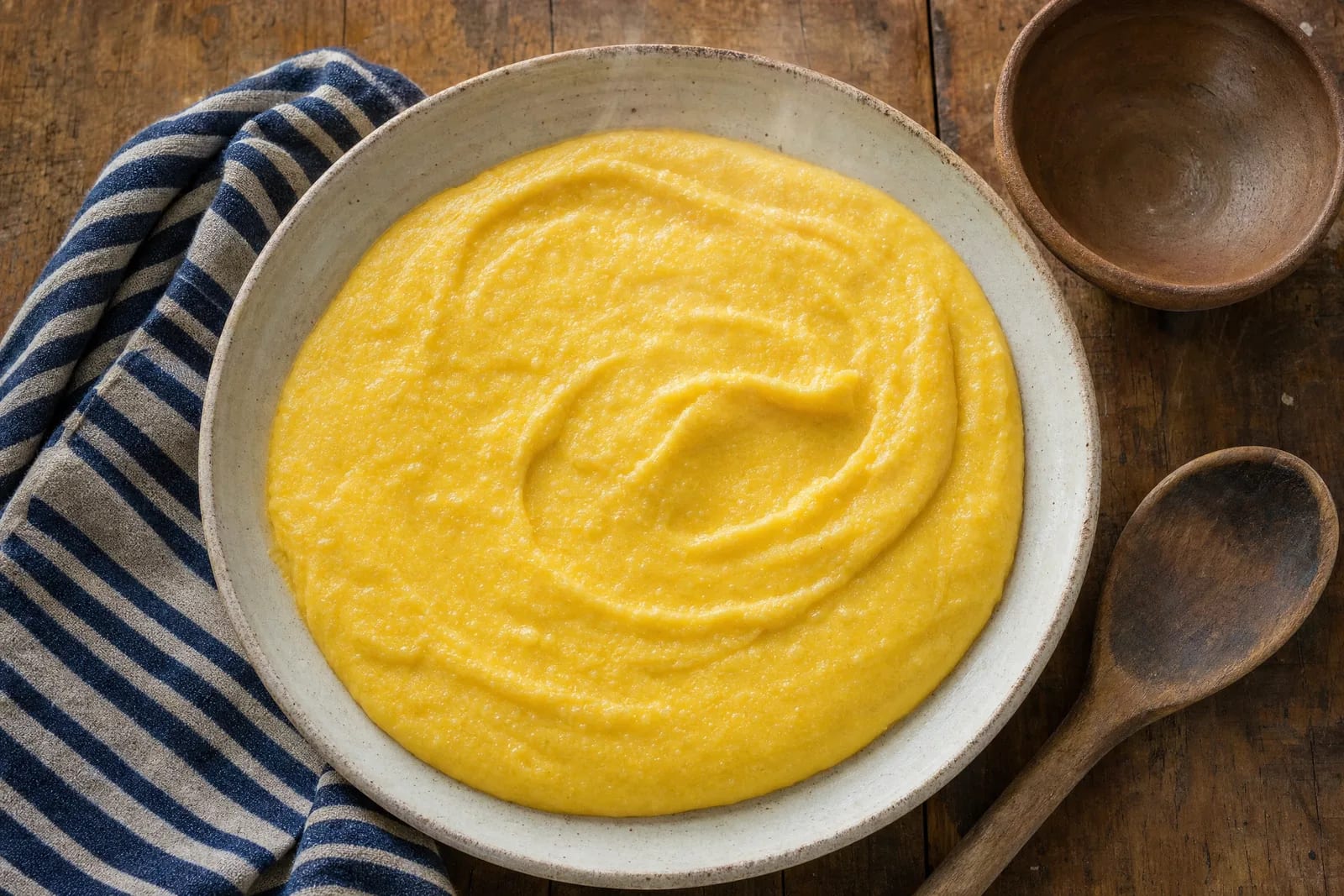
Served steaming, angu de fubá — a soft porridge of fine cornmeal — spreads in the serving dish as a golden, yielding layer, made to receive the broth from chicken with okra, pot-roasted meat, or a ladleful of beans.
Behind the flavor
Few preparations capture the flavorful economy of Minas cooking as well as angu: fubá, water, salt, and a spoon that never stops moving. It commonly reaches the table as a welcoming base for dishes cooked in a pot, especially alongside chicken with okra. The pairing of beans, angu, and collard greens is so distinctive in Minas cooking that it gave its title to Eduardo Frieiro's essay on the food of Minas Gerais.
📜 Ingredients
- •Corn fubá1 cup
- •Water1.2 liters (5 cups), divided
- •Salt1 teaspoon, or to taste
👨🍳 Method
- 1
Sift the corn fubá into a bowl. Add 500 ml (2 cups) of cold water and whisk until no lumps remain; set aside.
Starting with cold water keeps the fubá from forming lumps when it meets the hot pot.
- 2
Bring the remaining 700 ml (3 cups) of water and the salt to a steady boil in a heavy-bottomed pot over medium heat, 5 to 7 minutes.
The water should be bubbling before the dissolved fubá goes in.
- 3
Lower the heat and pour in the dissolved fubá in a thin stream, whisking continuously. Cook for 20 to 25 minutes, alternating between the whisk and wooden spoon, until the angu thickens and pulls slightly away from the sides of the pot.
If it thickens before it is fully cooked, add hot water a little at a time, only until it regains a smooth creaminess.
- 4
Taste for salt and transfer the angu to a warmed serving dish. Serve immediately; on a wood-burning stove, keep the pot well away from the direct flame and stir with extra care for 20 to 25 minutes, until it reaches the same creamy consistency.
Angu cools and firms quickly; a warm serving dish keeps it soft at the table.
🥃 Pairing
With cachaça
Unaged/silver
Cachaça from a Minas alambique, with an herbal, citrusy profile, served chilled in a small pour.
Its lightness refreshes the palate between spoonfuls of angu and pairs precisely with the dish when it comes topped with chicken and okra; cachaça from Salinas is a choice consistent with local tradition.
Lightly golden/rested
Cachaça lightly rested in wood, with a medium body and subtle vanilla notes.
It works when the angu accompanies pot-roasted meats: the subtle wood notes speak to the broths without overshadowing the flavor of corn.
Also pairs well with
✈️ A flavor worth the trip
At markets and open-air fairs in Minas Gerais, look for locally produced corn fubá and notice its grind: small differences in texture change the angu and bring the preparation closer to the flavor of farmhouse kitchens.
💡 Quick tips
- •Stirring continuously at the start of cooking is the surest route to a lump-free texture.
- •Use a taller pot than seems necessary: hot angu can release vigorous bubbles.
- •To serve it in slices, let the angu set in a greased baking dish for 1 to 2 hours before cutting.
- •To accompany chicken with okra, choose the creamier version, able to welcome the sauce.
🤔 Did you know?
Beans, angu, and collard greens form such a recognizable trio on the table of Minas Gerais that they inspired the title of Eduardo Frieiro's 1982 book Feijão, angu e couve: ensaio sobre a comida dos mineiros.
Small discoveries
- Fubá de milho · ingredient
- Fine flour made by milling dried corn, used to give angu body and flavor.
- Angu · technique
- A preparation of corn fubá and water, stirred until thickened and smooth, creamy, or firm in texture.
- Fogão a lenha · cultural expression
- A stove fueled by wood, traditionally found in rural and farmhouse kitchens in Minas Gerais.
📚 References
- Universidade Federal de Minas Gerais (UFMG), Espaço do Conhecimento. 3 eventos gastronômicos na Região Metropolitana de BH!, 2024. https://www.ufmg.br/espacodoconhecimento/blog-espaco/3-eventos-gastronomicos-na-regiao-metropolitana-de-bh/
- Frieiro, Eduardo. Feijão, angu e couve: ensaio sobre a comida dos mineiros. 2. ed. Belo Horizonte: Itatiaia; São Paulo: EDUSP, 1982.
- Secretaria de Estado de Cultura e Turismo de Minas Gerais. Dia da Gastronomia Mineira celebra tradição e potencialidades, 2020. https://www.secult.mg.gov.br/noticias-artigos/131-antigas/6042-dia-da-gastronomia-mineira-celebra-tradicao-e-potencialidades-em-5-de-julho
Keep discovering