.webp&w=1920&q=82)
.webp&w=1920&q=82)
.webp&w=1920&q=82)
.webp&w=1920&q=82)
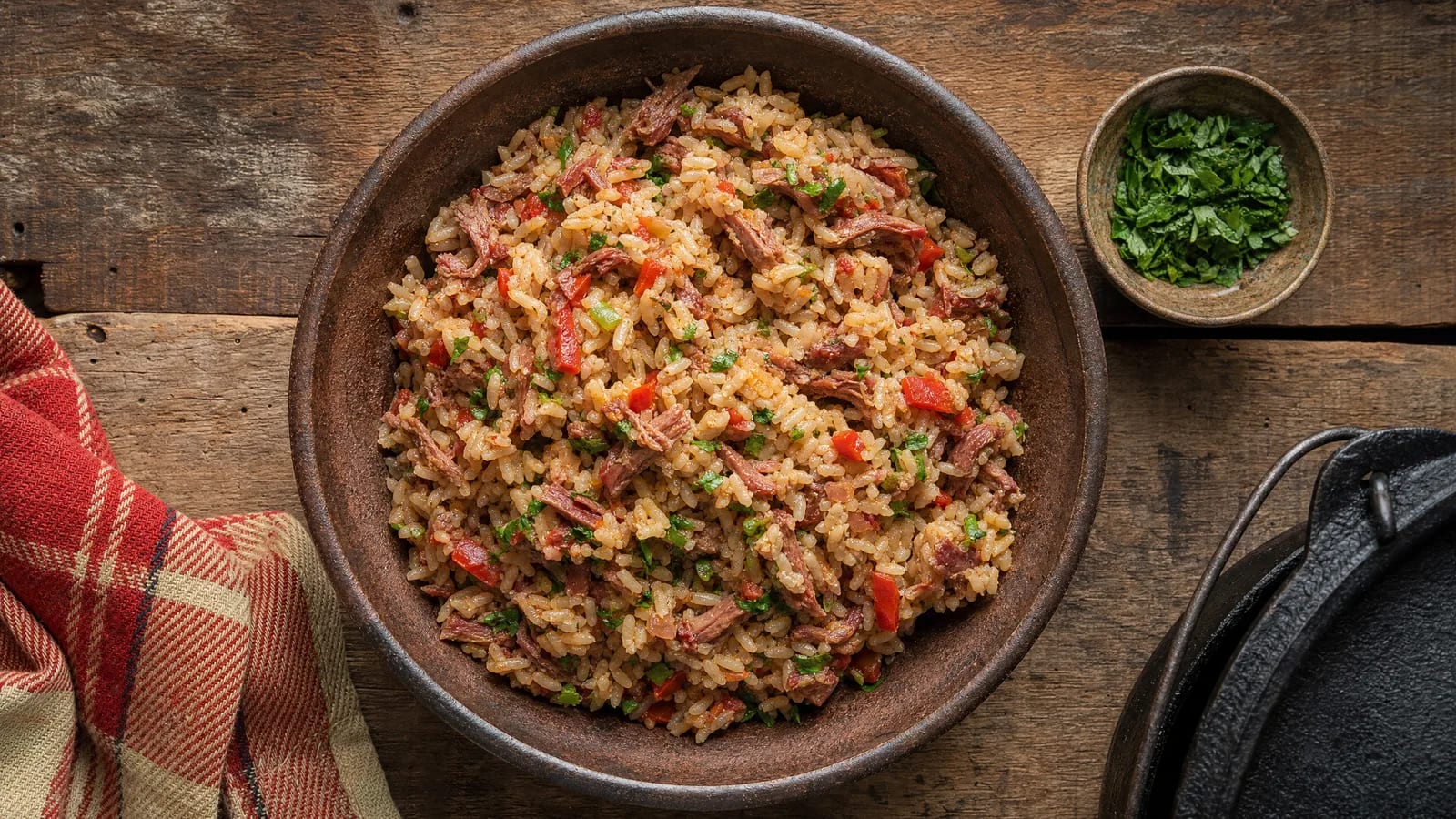
Arroz de carreteiro — rice cooked with dried beef — brings together rice, desalted charque, and a sauté of onion and tomato. A single pot concentrates the memory of the carreteiros, their carts, and the preserved meat that crossed long distances.
Behind the flavor
Arroz de carreteiro follows the logic of travel across the pampa: provisions that could withstand the road and a pot capable of feeding many people. Charque, heavily salted dried beef, linked home cooking to the economy of the charqueadas; rice completed a straightforward meal made over the fire. Today, the dish keeps that gaucho memory, although each household adjusts the sauté, the moisture, and the amount of meat.
📜 Ingredients
- 🥩charque500 g (1 lb 2 oz), in large cubes🔁 dried beef — Use well-desalted dried beef; its flavor is usually less intense than charque.
- •rice2 cups
- •lard or vegetable oil2 tablespoons
- •onion1 large onion, chopped
- •garlic3 cloves, minced
- •tomato2 ripe tomatoes, seeded and chopped
- •red bell pepper1/2 pepper, chopped
- •hot waterenough to cover the rice by about one finger-width
- •chopped parsley and scallions3 tablespoons, chopped
- •black pepperto taste
👨🍳 Method
- 1
To desalt the charque, rinse it under running water, cover with cold water, and soak in the refrigerator for 12 hours. Change the water at least three times, every 3 or 4 hours.
Cut off a small piece and taste it before cooking: it should be flavorful, not overly salty.
- 2
Drain the charque, cover with fresh water, and cook in a pressure cooker for 20–25 minutes after it reaches pressure, until tender. Let the pressure release, shred or cut into small cubes, and set aside.
In a regular pot, cook for 50–70 minutes, keeping enough water to cover the meat.
- 3
Heat the lard or oil in a heavy-bottomed pot over medium heat for 1 minute. Add the charque and fry for 4–6 minutes, until browned around the edges and fragrant with toasted notes.
Do not add salt at this stage: the charque will finish seasoning the rice.
- 4
Add the onion, garlic, and red bell pepper; sauté for 4–5 minutes, until the onion is translucent. Add the tomato and cook for 3 minutes, until it partially breaks down.
Scrape the bottom of the pot with the wooden spoon to incorporate the flavors of the sauté.
- 5
Add the rice and stir for 1–2 minutes, until the grains are glossy. Add hot water until it covers the rice by about one finger-width; season with black pepper, partially cover, and cook over low heat for 15–18 minutes, until the grains are tender and the liquid is nearly gone.
If needed, add more hot water little by little, always only enough to finish cooking.
- 6
Turn off the heat, stir in the parsley and scallions, and let the arroz de carreteiro rest, covered, for 5 minutes. Fluff the grains gently and serve hot.
The final rest sets the grains without drying out the pot.
🥃 Pairing
With cachaça
Aged/woody, from another state
oak-aged cachaça, dry and structured, with notes of vanilla, restrained caramel, and a long finish
The wood speaks to charque’s cured flavor and the rice’s texture. In Rio Grande do Sul, a young local red is the more natural pairing; cachaça should be presented transparently as an expression of another producing region.
Also pairs well with
✈️ A flavor worth the trip
Compare charque from a known producer with ordinary dried beef, always after desalting. The difference in curing emerges in the aroma of the pot and shows why this ingredient has traveled through the food history of the South.
💡 Quick tips
- •Desalting must happen under refrigeration to keep the charque safe over the 12 hours.
- •Use ripe tomatoes and remove the seeds for moist rice without excess liquid.
- •For a leftovers version, shred leftover churrasco and reduce the amount of charque; do not skip desalting if charque is included.
- •Serve with a fried egg, farofa, or green salad, keeping the pot at the center of the meal.
🤔 Did you know?
The dish’s name recalls the carreteiros, cart travelers who needed food that could withstand the journey and be prepared in a single pot. Charque fulfilled that role because salting and drying extended the meat’s keeping time.
Small discoveries
- Charque · ingredient
- Salted, dried beef developed as a preservation method and closely tied to the food history of Rio Grande do Sul.
- Dessalga · technique
- The process of soaking cured meat in cold water and refreshing the water to reduce excess salt.
- Carreteiro · cultural expression
- A name linked to cart travelers and to rice prepared with preserved meat in a single pot.
📚 References
- SABORES AJINOMOTO. Carreteiro de Charque Tradicional do Rio Grande do Sul, 2024. https://www.saboresajinomoto.com.br/blog/carreteiro-de-charque-tradicional-do-rio-grande-do-sul
- UNIVERSIDADE FEDERAL DE PELOTAS (UFPel). Pesquisas e acervos sobre as charqueadas de Pelotas. https://portal.ufpel.edu.br/
- IBGE. Produção Agrícola Municipal: arroz no Rio Grande do Sul. https://www.ibge.gov.br/
Keep discovering