.webp&w=1920&q=82)
.webp&w=1920&q=82)
.webp&w=1920&q=82)
.webp&w=1920&q=82)
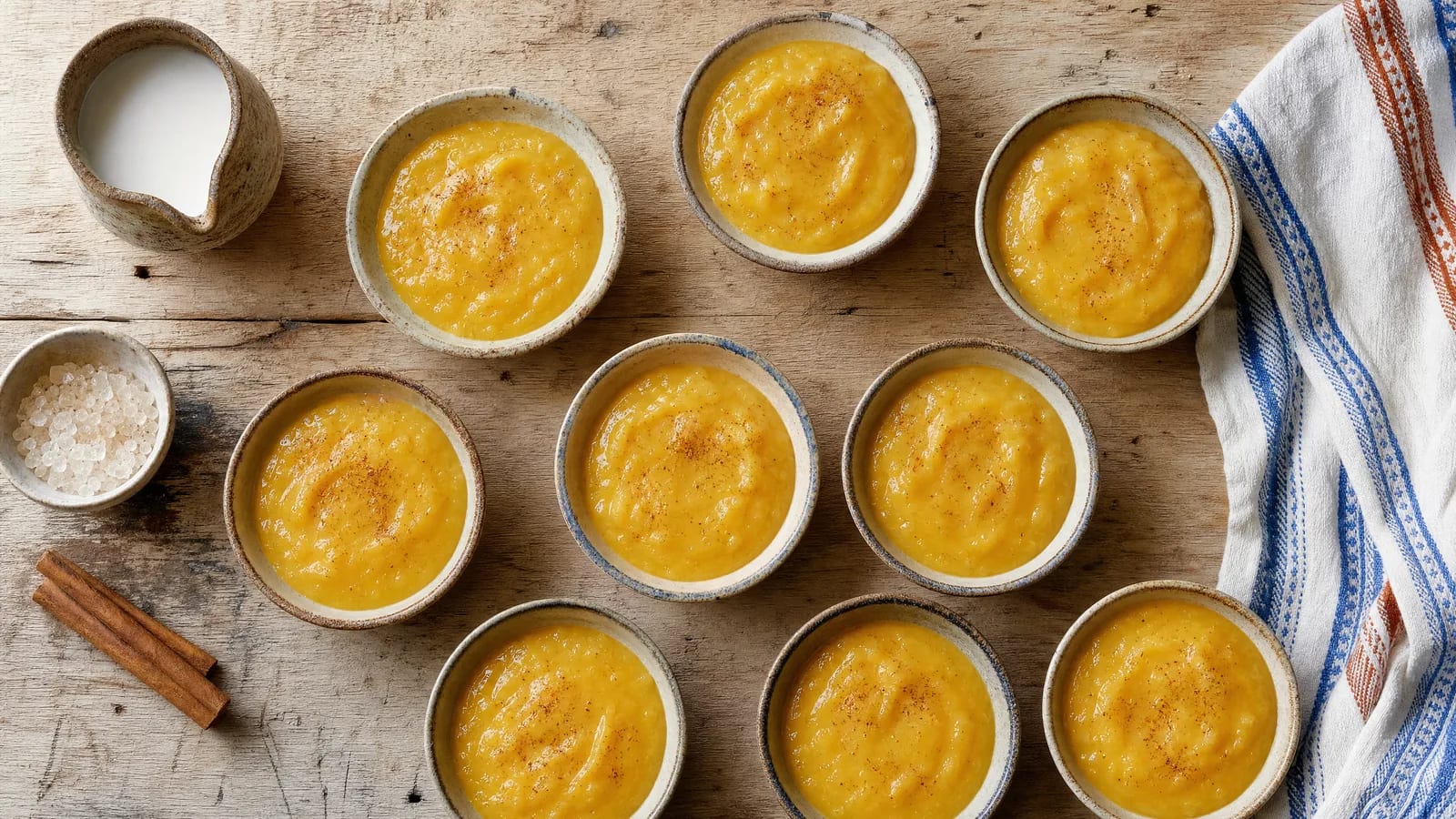
Baba de moça is an egg-yolk cream scented with coconut milk and bound with sugar syrup. Served cold in small portions, it moves slowly on the spoon and belongs to Bahia’s repertoire of sweets, where coconut meets time-honored confectionery techniques.
Behind the flavor
In Bahia, coconut milk brings baba de moça close to the flavor landscape that also sustains cocadas — chewy coconut sweets —, tapioca-and-coconut fritters and Brazilian coconut egg custards. Its place among the foundational sweets of Bahian confectionery resists a simplified origin story: instead, it reveals how egg-yolk preparations were made tropical through coconut and found their way onto festive tables and into sweet shops. The Instituto Brasil a Gosto describes Bahian sweets as the result of an encounter among Portuguese techniques, local ingredients and African contributions; it is within this fabric, woven from labor and transmission, that this cream is best appreciated.
📜 Ingredients
- 🥥coconut milk200 ml (7 fl oz)🔁 ready-made culinary coconut milk — The recipe will still work, but the aroma will be less fresh and the texture may be more uniform.
- •granulated sugar200 g (7 oz)
- •water100 ml (3.4 fl oz)
- •egg yolks8
- •cinnamon stick1 small piece
- •salt1 pinch
👨🍳 Method
- 1
Place the sugar, water and cinnamon stick in the saucepan. Bring to medium heat and, once the sugar has dissolved, do not stir; cook for 6 to 8 minutes, until a clear syrup forms delicate threads when you lift the spoon.
If crystals form along the sides, run a damp pastry brush around the rim of the pan only.
- 2
Add the coconut milk and pinch of salt to the syrup. Cook over low heat for 2 to 3 minutes, only until smooth again; remove the cinnamon stick.
Low heat keeps the coconut milk from boiling aggressively and separating.
- 3
Pass the yolks through a fine-mesh sieve without pressing on the membrane. In a bowl, whisk 3 tablespoons of the warm syrup into the yolks, one tablespoon at a time, to temper them.
This gradual adjustment in temperature keeps the yolks from cooking into strands.
- 4
Pour the tempered yolks into the pan with the syrup and cook over the lowest heat for 7 to 10 minutes, stirring continuously with a spatula, until it reaches the nappé stage: the cream should coat the back of a spoon and leave a brief trail when you run a finger through it.
Do not let it boil. As soon as it reaches the nappé stage, remove it from the residual heat.
- 5
Transfer to a heatproof bowl, press plastic wrap directly onto the surface and let cool until barely warm. Divide among dessert cups and refrigerate for at least 1 hour before serving.
🥃 Pairing
With cachaça
Rested cachaça from Abaíra
Lightly aged golden style, soft, with restrained oak
Its moderate dryness and woody note balance the richness of the yolks without overshadowing the coconut milk.
Cachaça aged in amburana wood
Intensely aged, with vanilla, cinnamon and spice
Cinnamon and vanilla echo the cream; serve a small pour as an accompaniment to dessert.
Also pairs well with
✈️ A flavor worth the trip
Try making the coconut milk at home by blending fresh coconut flesh with warm water and straining it. The gesture takes only a few minutes and radically changes the cream’s final fragrance.
💡 Quick tips
- •Strain the yolks gently to soften their pronounced egg aroma.
- •Use the lowest heat for the final stage; a high boil will curdle the cream.
- •Baba de moça should flow slowly from the spoon, not set firm like brigadeiro.
- •Serve it plain, with slices of fresh coconut, or use it to fill a simple cake.
🤔 Did you know?
The right stage is not that of a thick syrup: baba de moça develops most of its body as it cools. Taking it off the heat while it still looks like a fluid cream preserves its smooth, velvety texture.
Small discoveries
- Leite de coco · ingredient
- The liquid pressed from the coconut’s white flesh, used to bring fragrance, richness and tenderness to sweets.
- Ponto de napê · technique
- A cream stage at which the mixture coats the back of a spoon and briefly holds the line drawn by a finger.
- Tacho · cultural expression
- A wide pan traditionally associated with making sweets in larger quantities and with the patient work of a wooden spoon.
📚 References
- Instituto Brasil a Gosto. Desserts from Bahia. Google Arts & Culture. https://artsandculture.google.com/story/desserts-from-bahia-institutobrasilagosto/0gXB78uT6BONXQ
- COSTA, Matheus Magalhães; VIANA JUNIOR, Fernando Santa Clara; COSTA, Victor Sampaio Daltro. A doçaria tradicional das baianas de acarajé e os redesenhos dos doces de tabuleiros. Ágora, v. 26, n. 2, 2025. https://doi.org/10.17058/agora.v26i2.19590
- CASCUDO, Luís da Câmara. História da Alimentação no Brasil. Global, 2016.
- EMBRAPA Mandioca e Fruticultura. Referências técnicas sobre coco e fruticultura tropical.
- INPI. Indicação Geográfica da Cachaça de Abaíra, Chapada Diamantina, 2014.
Keep discovering