.webp&w=1920&q=82)
.webp&w=1920&q=82)
.webp&w=1920&q=82)
.webp&w=1920&q=82)
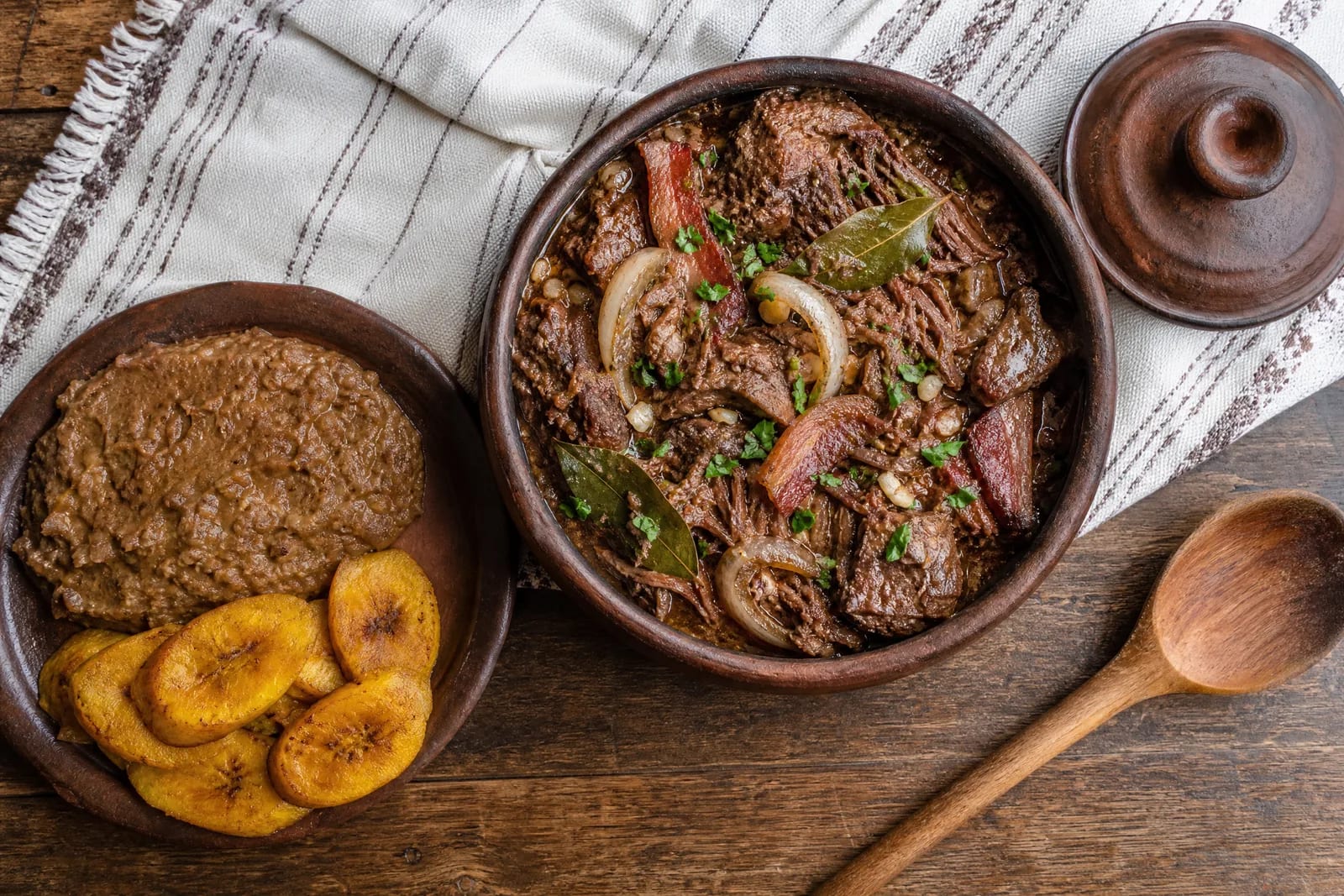
In a sealed clay pot, beef and seasonings spend hours over a gentle flame until they become almost a single broth. At the table, white cassava flour makes pirão — a thick porridge of broth and cassava flour —, while plantain brings the sweet counterpoint that made barreado renowned.
Behind the flavor
In Antonina, Morretes, and Paranaguá, barreado belongs to a landscape of colonial houses, rivers, and descents from the Serra do Mar. The technique of sealing the pot with a flour dough preserves the memory of Caiçara coastal communities and Azorean settlers, strengthened in community celebrations and along the routes of colonial mule-train drovers. More than braised beef, it is a rite of shared patience: the coast’s dish, left on the fire while conversation lengthens.
📜 Ingredients
- •beef chuck, cut into large cubes1.2 kg (2.6 lb)🔁 beef shoulder — Choose a cut rich in collagen; it will break down more readily after the long cooking.
- •bacon strips150 g (5 oz)
- •onion, thinly sliced into half-moons3 medium
- •chopped garlic5 cloves
- •ground cumin1 level tablespoon
- 🍗bay leaves3
- •chopped parsley1/2 cup
- •white wine vinegar2 tablespoons🔁 lemon juice — Use the same amount; the flavor will be more citrusy.
- •salt1 1/2 teaspoons, or to taste
- •ground black pepper1 teaspoon, or to taste
- •white cassava flour2 cups for serving, plus more as needed for sealing
- •waterenough to make the sealing dough
- •ripe plantains, sliced into rounds3
- •orange segments2 oranges
👨🍳 Method
- 1
Season the beef chuck with the onion, garlic, ground cumin, bay leaves, parsley, white wine vinegar, salt, and black pepper. Cover and refrigerate for 30 to 60 minutes, just long enough for the flavors to come together.
The beef needs no added water: in traditional barreado, the ingredients themselves release the liquid needed during the long cooking.
- 2
Line the bottom of the clay pot with the bacon strips. Arrange all the seasoned beef and its seasonings on top without packing them too tightly.
The bacon forms a layer of fat at the bottom and helps keep the beef from catching before it begins to release its juices.
- 3
Gradually mix the white cassava flour with water until it forms a firm, pliable dough that does not run. Close the pot and cover the entire seam between lid and rim with the dough: this is the barreada seal.
Use the clean cloth to dry the rim thoroughly before applying the dough; the seal must be continuous.
- 4
Set the pot over the lowest heat and cook for 8 to 11 hours, keeping it at a very gentle simmer. It is ready when the steam subtly scents the kitchen and the beef yields without resistance to the touch of a spoon.
Do not open the pot while it cooks; if the heat is too high, lower it at once so the bottom does not burn.
- 5
Turn off the heat and wait 15 minutes. Break the seal, open the pot, and stir the beef with the wooden spoon until it comes apart into thick strands in its own broth.
Taste only now and adjust the salt if needed.
- 6
In each soup plate, spread a layer of white cassava flour and cover it with the piping-hot barreado, stirring to form a soft pirão. Serve with plantain and orange segments.
Add the flour to the plate, not to the whole pot, so each person can adjust the texture to their liking.
🥃 Pairing
With cachaça
Aged cachaça from Morretes
Aged and wood-influenced, with integrated oak and moderate warmth.
Its wood notes follow the cumin, the bacon fat, and the depth of beef cooked for hours without competing with the pirão.
Also pairs well with
💡 Quick tips
- •Plan ahead: the long cooking is essential to the dish, not a step to be shortened.
- •If the clay pot is new, follow the manufacturer’s instructions for curing it and using it on the stove.
- •Keep the simmer quiet; vigorous bubbling compromises the beef’s tenderness and can scorch the bottom.
- •The plantain and orange are not garnishes: they brighten the broth’s richness and belong to the traditional serving.
🤔 Did you know?
The dish takes its name from the barreada: the dough seal that closes the pot and sustains its slow cooking. Barreado from Paraná’s coast has a registered Indication of Source from INPI.
Small discoveries
- Barreada · technique
- A seal made of flour dough and water around the lid, used to close the pot tightly during cooking.
- Cominho moído · ingredient
- A spice with an earthy, warm fragrance, central to barreado’s seasoning.
- Farinha de mandioca branca · ingredient
- Dry, coarse cassava flour used in the dish to give body to the broth and make pirão.
- Barreado · cultural expression
- An emblematic dish of Paraná’s coast, associated with Morretes, Antonina, and Paranaguá and traditionally served with flour, plantain, and orange.
📚 References
- Sebrae/PR — Origens Paraná: Barreado do Litoral do Paraná. https://sebraepr.com.br/origens-parana/barreado-do-litoral-do-parana/
- Secretaria de Estado da Cultura do Paraná / CPC-PR — referências sobre o registro do barreado como patrimônio cultural imaterial do Paraná.
- INPI — Indicação de Procedência Barreado do Litoral do Paraná.
Keep discovering