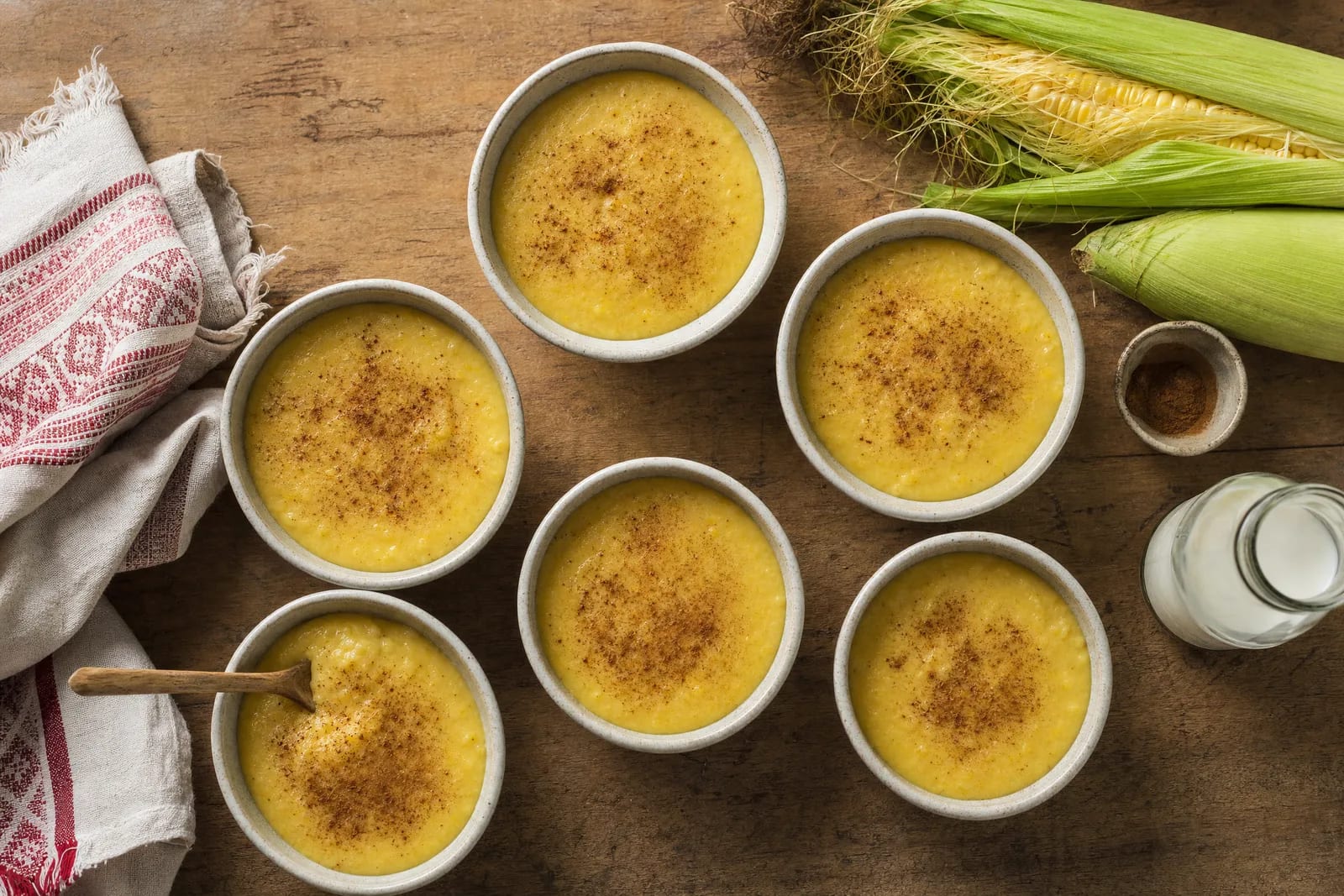
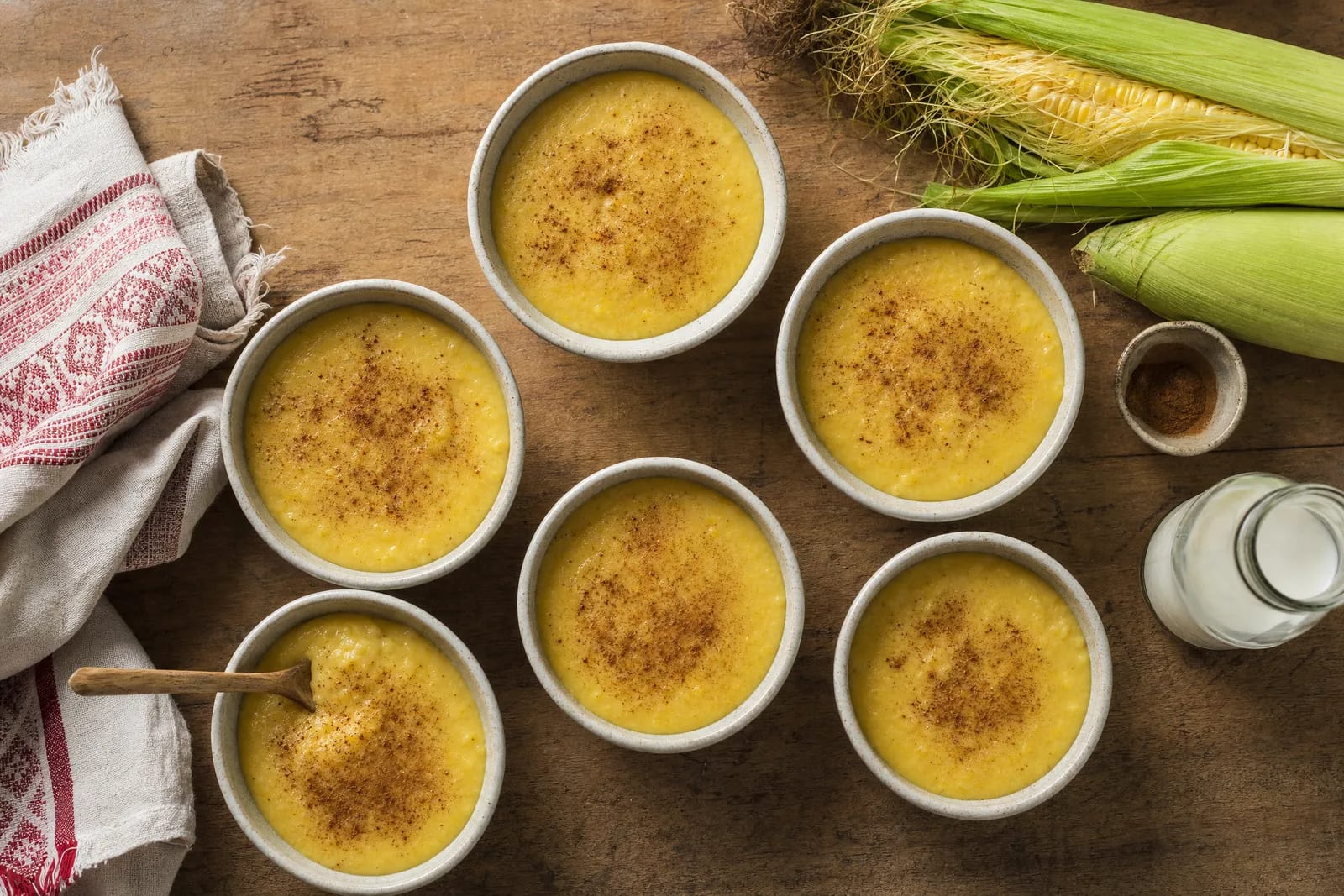
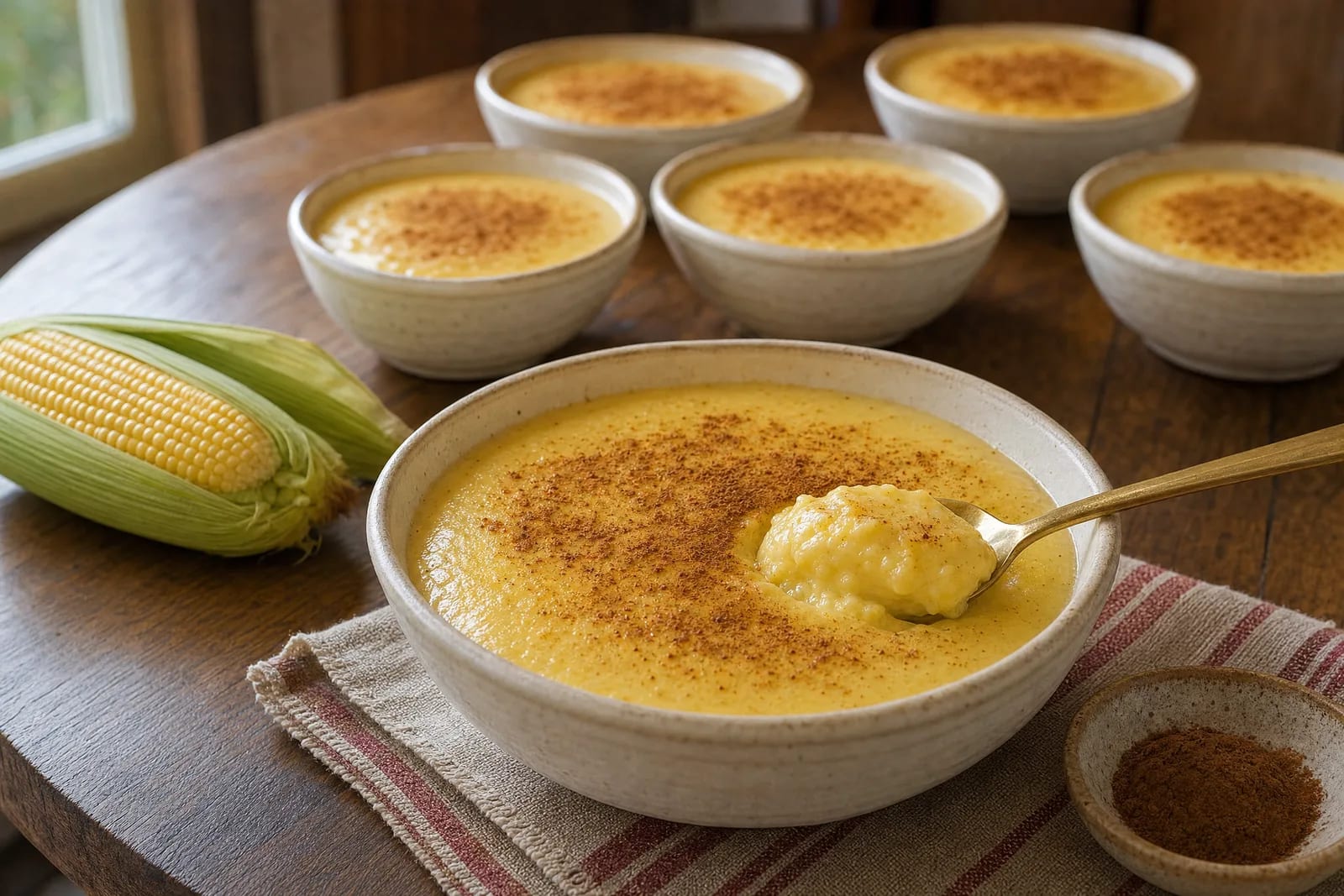
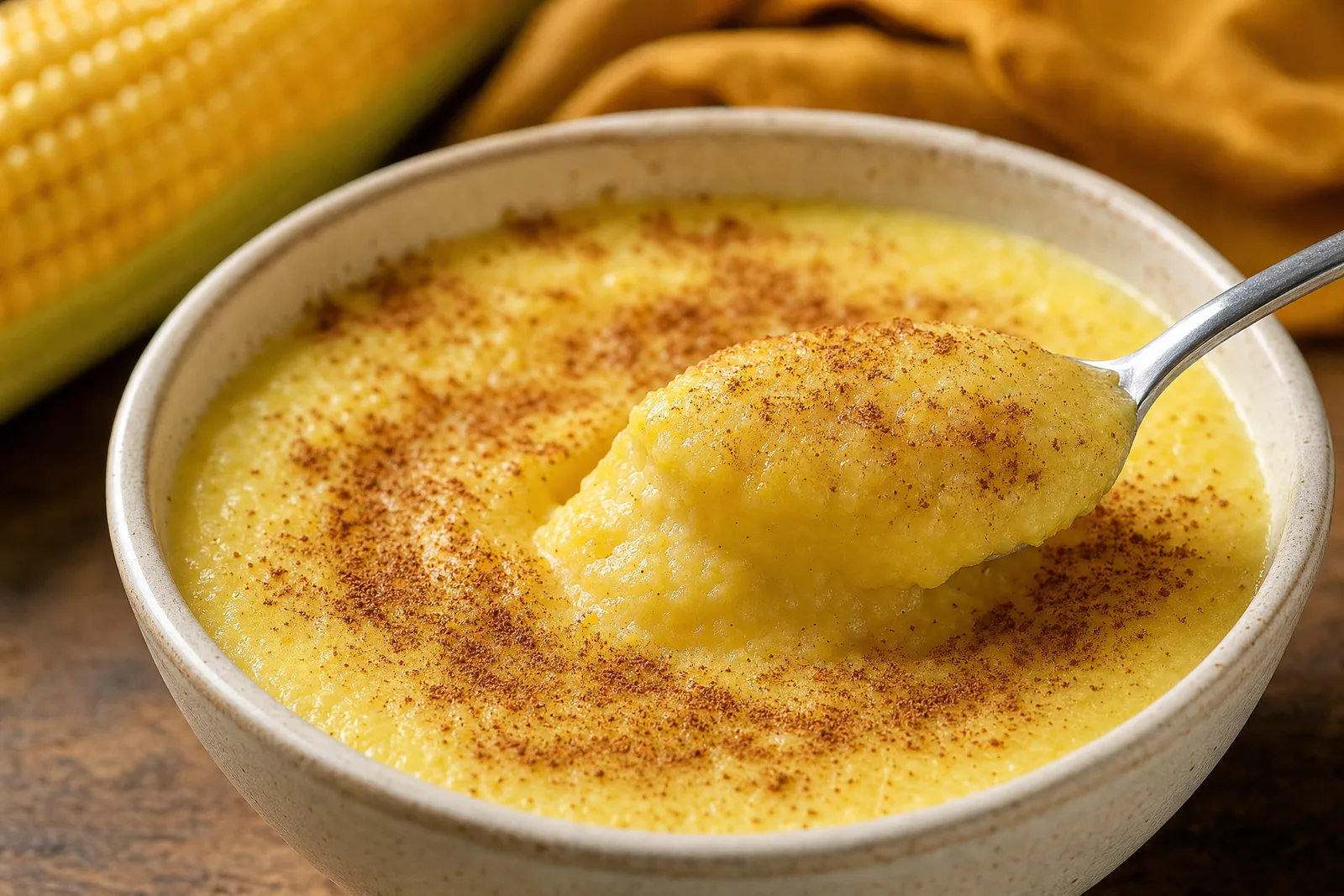
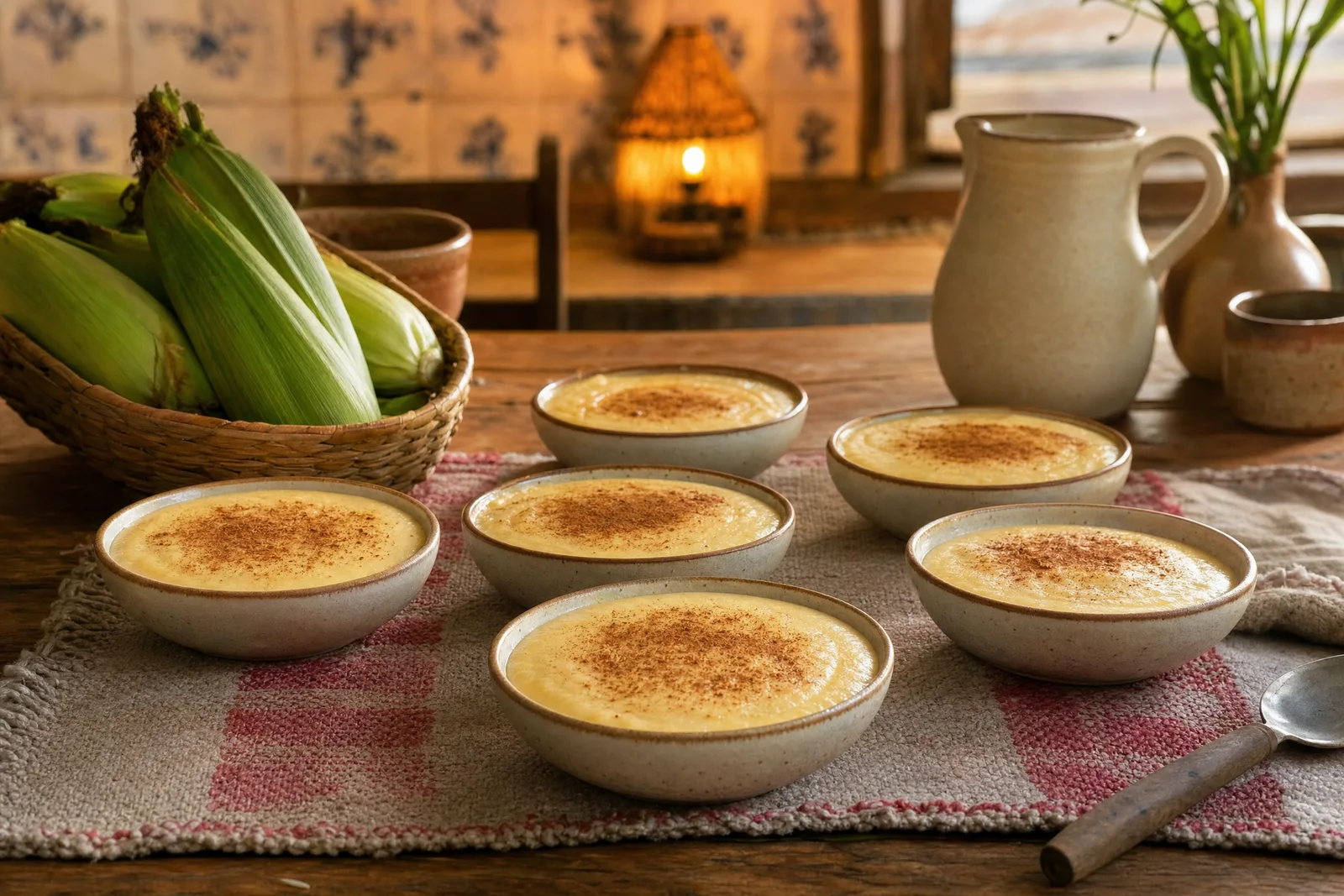
In curau—a soft sweet corn pudding—fresh corn becomes a spoonable cream: the ear is scraped, blended with milk, strained and cooked until it gains body. It is the flavor that reaches São Paulo's stalls when the June fair lights up and winter begins to call for a warm bowl.
Behind the flavor
Curau belongs to the corn repertoire that shapes São Paulo's rural table and the state's festas juninas—June harvest celebrations. In a report by Unesp, researcher Ana Carolina Viotti recalls that corn was especially important in the more southern areas, including São Paulo, where its use reaches back to Indigenous peoples and became part of colonial inland routes. At São Paulo festivities, the sweet sits alongside pamonha, cake and canjica, making the grain a language of harvest, gathering and memory.
📜 Ingredients
- •fresh corn8 medium ears, well filled🔁 frozen corn — Use about 800 g (28 oz), thawed and drained; the curau will be less fragrant and may need a few extra minutes over the heat.
- •whole milk3 cups (720 ml [24 fl oz])
- •sugar3/4 cup (150 g [5 oz])
- •salt1 pinch
- •ground cinnamonto taste, to finish
👨🍳 Method
- 1
Remove the husks and silk from the ears. With a small knife, cut the fresh corn kernels close to the cob, working over a bowl so none of the corn's natural milk is lost.
Run the back of the knife along the cob after cutting the kernels; this scraping captures the creamiest part of the ear.
- 2
Blend the fresh corn with the whole milk for 2 to 3 minutes, until thoroughly broken down. Pass it through a fine-mesh strainer, pressing the pulp with a spoon to extract as much thick liquid as possible.
Straining ensures a smooth curau; do not discard the liquid held in the pulp before pressing it.
- 3
Transfer the strained liquid to a heavy-bottomed saucepan with the sugar and salt. Cook over medium-low heat for 20 to 25 minutes, stirring constantly and scraping the sides, until it thickens, turns glossy, and the spatula leaves a slow trail across the bottom of the pan.
If it boils too vigorously, the curau may turn lumpy or catch on the bottom; lower the heat as soon as the first bubbles appear.
- 4
Divide the curau among the bowls and dust with ground cinnamon. Serve warm, or cover and chill for at least 2 hours, until lightly set; either way, it carries the corn of a São Paulo festa junina.
To unmold, lightly coat ramekins with a thin film of neutral oil before filling, then refrigerate until completely chilled.
🥃 Pairing
With cachaça
Light golden or rested cachaça
Round and gentle, with brief wood contact and subtle notes of cane, vanilla and caramel.
A small, well-chilled pour extends the notes of corn and cinnamon without overwhelming the cream's delicacy. Favor lightly wooded labels over intensely oaked spirits.
Also pairs well with
✈️ A flavor worth the trip
In June, look for fresh corn curau at neighborhood festivities and in towns across the São Paulo countryside. It is a simple way to taste how the grain, cultivated in the state for centuries, still shapes the season of June fairs.
💡 Quick tips
- •Ears with plump, milky kernels give curau its natural thickness; traditional recipes do not need cornstarch.
- •Stir until it reaches a thick cream consistency: as it cools, the curau will continue to set.
- •Add the cinnamon at the end to perfume the dish without masking the flavor of fresh corn.
🤔 Did you know?
In Brazil's Southeast, the name curau is customary; the USP School of Public Health notes that in the Northeast, the same corn sweet is called canjica, while the southeastern canjica is known there as mungunzá. The shifting names reveal how one Brazilian celebration holds distinct regional vocabularies.
Small discoveries
- Milho verde · ingredient
- Corn harvested before drying, with tender, milky kernels, suitable for creams, pamonhas, cakes and other festa junina preparations.
- Coar · technique
- Passing a mixture through a strainer to separate solids and obtain a smoother liquid or cream.
- Festa junina · cultural expression
- A popular June celebration linked to Catholic saints and, in Brazil, reshaped by Indigenous and Afro-Brazilian practices, with corn dishes and communal gathering.
📚 References
- Jornal da Unesp — “Olhar histórico revela origens dos elementos tradicionais das festas juninas” (2023): https://jornal.unesp.br/2023/06/28/olhar-historico-revela-origens-dos-elementos-tradicionais-das-festas-juninas/
- Universidade de São Paulo, Faculdade de Saúde Pública — “Festas juninas: origem e celebração” (2023): https://eccco.fsp.usp.br/index.php/2023/06/13/festas-juninas-origem-e-celebracao/
- Prefeitura de São Paulo — “Festa junina: Centros Culturais recebem arraiás...” (2025), programação que registra pamonha e curau entre as delícias juninas: https://todospelocentro.prefeitura.sp.gov.br/noticias/festa-junina-centros-culturais-recebem-arraias-barracas-com-comidas-tipicas-quadrilhas-e-shows-neste-mes
Keep discovering