.webp&w=1920&q=82)
.webp&w=1920&q=82)
.webp&w=1920&q=82)
.webp&w=1920&q=82)
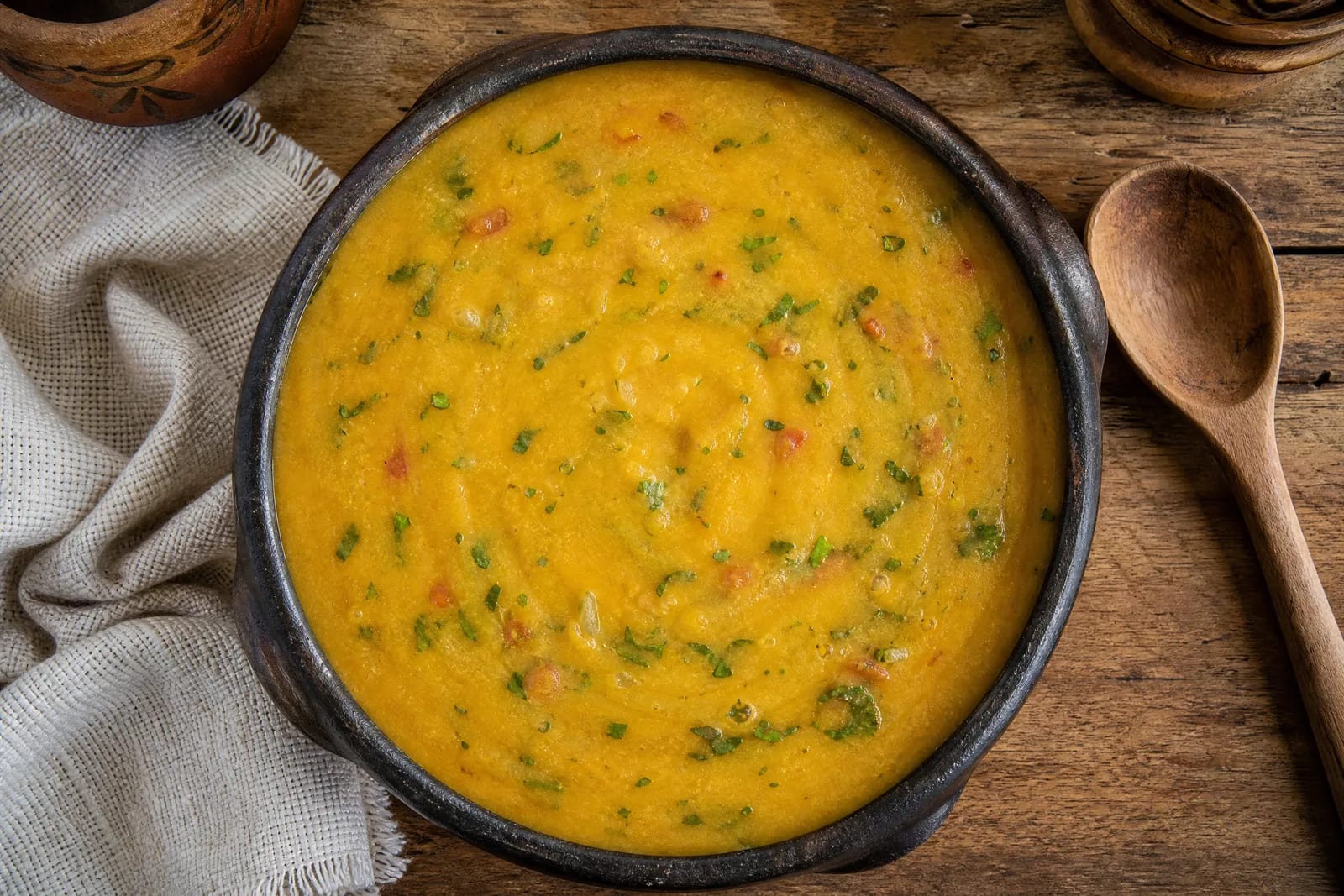
Made with fish stock, cassava flour, tomato, cilantro, and annatto, this pirão accompanies Capixaba moqueca — a slow-simmered fish stew —, extending the taste of the coast one spoonful at a time.
Behind the flavor
In Espírito Santo, pirão is the accompaniment that gathers up the broth of Capixaba moqueca and turns it into food for sharing. An official recipe published by Guarapari City Hall presents moqueca served with pirão, rice, and moqueca de banana-da-terra. When made in a Goiabeiras clay pot, it comes even closer to a body of knowledge that shaped the image of Capixaba cooking: the pot makers’ craft was entered in IPHAN’s Registry Book of Knowledge in 2002.
📜 Ingredients
- •homemade fish stock600 ml (2 1/2 cups), very hot🔁 homemade vegetable stock — The pirão will lose the maritime depth that ties it to moqueca.
- •fine cassava flour3/4 cup, about 90 g (3 oz)🔁 biju cassava flour, quickly ground — The texture will be more granular and less silky.
- •annatto oil1 tbsp🔁 annatto powder dissolved in 1 tbsp olive oil — The color comes close, but the aroma of fresh annatto is subtler.
- •onion1/2 small onion, finely chopped
- •tomato1 small tomato, seeded and chopped
- •cilantro2 tbsp, chopped🔁 parsley — The substitution softens the characteristic fragrance of the Capixaba coastal table.
- •saltto taste
👨🍳 Preparation
- 1
Have the fish stock ready and very hot. If it comes from moqueca, strain out any bones and keep it over low heat while you chop the onion, tomato, and cilantro.
The stock should be flavorful before the flour goes in; adjust the salt sparingly, as the liquid may already have reduced.
- 2
Warm the annatto oil over low heat for 1 to 2 minutes, preferably in a Goiabeiras clay pot, until fragrant but not smoking. Add the onion and sauté for 2 minutes, until translucent.
A clay pot retains heat; lower the flame if the bottom begins to darken quickly.
- 3
Add the tomato and cook for 2 to 3 minutes, stirring, until softened and beginning to release its juices. Add the fish stock and half the cilantro; boil for 3 to 5 minutes, until the flavors meld and the tomato softens at the edges.
A brief boil brings the seasonings together without turning the stock into a thick sauce.
- 4
With the stock at a gentle simmer, sprinkle in the fine cassava flour little by little, stirring constantly with a wooden spoon. Cook for 2 to 4 minutes, until the pirão thickens, turns smooth, and falls from the spoon in a thick ribbon.
If it goes beyond the desired consistency, incorporate more hot stock one ladle at a time; if it is too thin, add more flour gradually.
- 5
Taste, adjust the salt, and stir in the remaining cilantro off the heat. Serve the pirão piping hot beside Capixaba moqueca.
The traditional consistency is creamy and fluid enough to ladle, not firm like polenta.
🥃 Pairing
With cachaça
White or silver cachaça from an alambique
Light, herbal, and citrusy, served chilled.
Its freshness follows the fish stock and cilantro without obscuring the pirão’s maritime delicacy.
Light, rested yellow cachaça
Smooth, with a discreet passage through wood and low tannin intensity.
The subtle wood speaks to the annatto and tomato while preserving the creamy texture and keeping the stock in the foreground.
Also pairs well with
✈️ A flavor worth the trip
If you are in Vitória, seek out a Goiabeiras clay pot and notice the dark finish achieved with mangrove tannin dye. Bringing pirão to that pot places the accompaniment closer to the territory that made it inseparable from Capixaba moqueca.
💡 Quick tips
- •Use fine cassava flour and always add it little by little to prevent lumps.
- •Set aside one ladle of hot stock before thickening; it corrects the pirão without diluting the seasoning.
- •To honor the Capixaba profile, choose stock from a moqueca made without coconut milk or dendê oil.
- •Serve immediately; as it rests, pirão continues to absorb liquid and set.
🤔 Did you know?
The Goiabeiras pot makers’ craft, associated with the clay pot that holds moqueca and its accompaniments, was the first cultural asset entered by IPHAN in the Registry Book of Knowledge in 2002.
Pequenas descobertas
- Farinha de mandioca fina · ingredient
- Flour made from cassava and more delicately ground, ideal for thickening broths evenly.
- Óleo de urucum · ingredient
- Oil colored with annatto seeds, used to give dishes an orange-red hue and gentle aroma without spiciness.
- Panela de barro de Goiabeiras · cultural expression
- A handcrafted clay pot made in Goiabeiras, Vitória, according to a craft registered by IPHAN as intangible cultural heritage.
📚 References
- Prefeitura Municipal de Guarapari. Receita Moqueca Capixaba. https://www.guarapari.es.gov.br/pagina/ler/2138/receita-moqueca-capixaba
- Panelinha. Moqueca capixaba. https://panelinha.com.br/receita/moqueca-capixaba
- IPHAN — Instituto do Patrimônio Histórico e Artístico Nacional. Ofício das Paneleiras de Goiabeiras. https://www.gov.br/iphan/pt-br/patrimonio-cultural/imaterial/bens-registrados/oficio-das-paneleiras-de-goiabeiras
Keep discovering