.webp&w=1920&q=82)
.webp&w=1920&q=82)
.webp&w=1920&q=82)
.webp&w=1920&q=82)
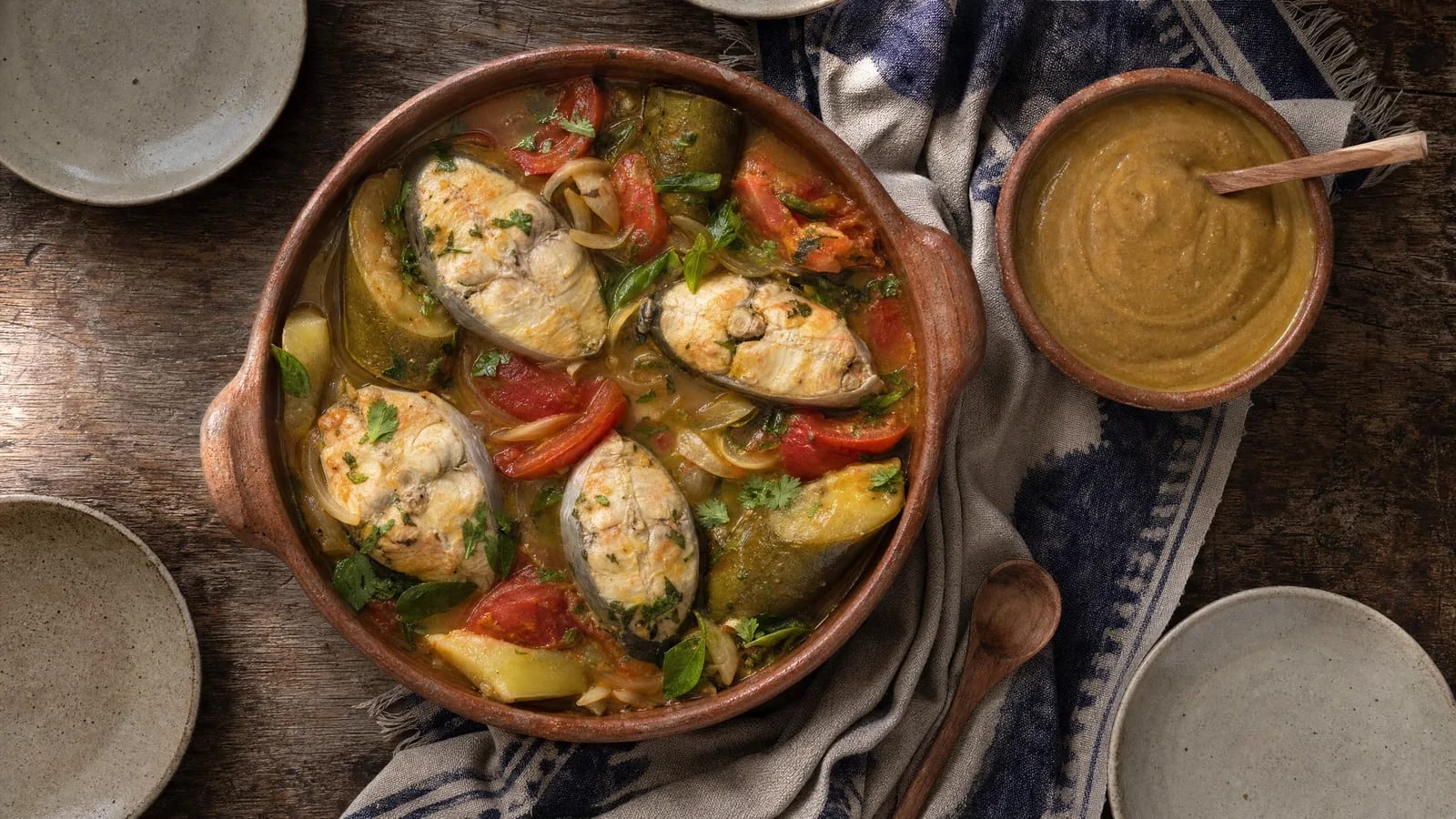
Azul-marinho is a caiçara preparation—of Brazil's traditional coastal fishing communities—of fish steaks simmered with green plantain; some of the plantain and broth become a fluid pirão, a porridge of broth and cassava flour, served alongside.
Behind the flavor
In caiçara communities along the São Paulo coast, azul-marinho is born of the closeness between canoe, catch, and backyard garden. The dish does not seek to disguise the fish: it simmers the steaks with green plantain, herbs, and tomato, allowing the broth to gather what the coast provides. Cooked in its peel, the plantain can lend the liquid bluish glints, explaining the name that has made the recipe an affectionate emblem of the northern coast. It is a cuisine of careful use, in which the same broth nourishes the fish and gives body to the pirão.
📜 Ingredients
- •firm white-fish steaks1.2 kg (2.6 lb) cleaned grouper, white grouper, or weakfish🔁 shark steaks — The broth will be milder, and the fish will flake more readily.
- •green plantains5, with peels thoroughly washed🔁 green Cavendish bananas — A traditional alternative often cited for the dish, though softer and slightly sweeter.
- 🌾farinha-da-terra3/4 cup, plus more as needed to adjust the pirão🔁 finely toasted cassava flour — The pirão will take on a toastier flavor and lose some of the character of artisanal caiçara flour.
- •ripe tomatoes4, seeded and diced
- •onions2 medium, sliced
- •garlic3 cloves, sliced
- •cilantro1/2 cup, chopped
- •clove basil1/4 cup, chopped🔁 fresh basil — It preserves the fragrance of a fresh herb, though with less anise character.
- •lime1
- •olive oil2 tablespoons
- •hot water1.2 liters (5 cups), or enough to nearly cover the fish steaks
- •salt and black pepperto taste
👨🍳 Method
- 1
Wash the green plantains under running water, scrubbing the peels thoroughly, then cut each into 3 pieces without peeling. Season the firm white-fish steaks with salt, black pepper, and lime juice; let stand for 10 minutes, only while you cut the vegetables.
Use exceptionally fresh fish and keep it refrigerated until it goes into the pot.
- 2
Heat the olive oil in a large pot over medium heat. Sauté the onions and garlic for 3 to 4 minutes, until the onions begin to soften. Add the tomatoes, cilantro, and clove basil, then cook for 4 minutes, until they form a fragrant, moist base.
Add the clove basil at the beginning to scent the broth without overwhelming the fish.
- 3
Arrange the unpeeled green plantains over the sautéed vegetables and add enough hot water to nearly cover them. Cook over medium heat for 12 to 15 minutes, until they begin to yield to the tip of a knife. The peel may lend the broth the bluish glints that give azul-marinho its name.
Do not peel the plantains at this stage: their peel contributes to the broth’s visual identity and flavor.
- 4
Nestle the firm white-fish steaks among the plantains without stacking them. Partially cover and simmer gently for 8 to 12 minutes, until the flesh separates into thick flakes and loses its translucent look. Carefully remove the fish and a few plantain pieces; keep them warm on a covered platter.
Avoid a vigorous boil: it breaks up the fish steaks and clouds the broth.
- 5
For the pirão, peel 2 pieces of cooked plantain and mash them with a fork in a medium saucepan. Strain 2 1/2 cups of broth, add it to the plantain, and set over low heat. Sprinkle in the farinha-da-terra gradually, stirring for 4 to 6 minutes, until it forms a fluid pirão that falls slowly from the spoon.
If the pirão thickens too much, gradually add hot broth; it will continue to set after serving.
- 6
Adjust the salt in the remaining broth and serve the azul-marinho with the fish steaks, whole plantains, ladled broth, and pirão. Bring it to the table without delay, while the fish is still juicy and the pirão remains silky.
Plain white rice can accompany the dish, but let the pirão take center stage.
🥃 Pairing
With cachaça
White/silver
A young, vegetal, citrusy cachaça served chilled, with a clean finish.
Its lightness accompanies the fish and heightens the herbs’ freshness without obscuring the delicate sweetness of green plantain.
Light yellow/rested
A briefly rested, mellow cachaça with subtle wood and little perceived sweetness.
A small pour complements the pirão and broth without laying heavy notes over the fish.
Also pairs well with
✈️ A flavor worth the trip
If you find artisanal coastal farinha-da-terra, taste it before it goes into the pot: its grain, cassava aroma, and toast tell as much of azul-marinho’s story as the choice of fresh fish.
💡 Quick tips
- •Choose fish steaks about 3 cm (1 1/4 inches) thick: they hold together through cooking.
- •Green plantains should be firm and free of yellow spots; if too ripe, they sweeten and fall apart in the broth.
- •Add the farinha-da-terra only to the pirão, gradually and with hot broth, to preserve the thin texture that accompanies the fish.
🤔 Did you know?
In azul-marinho, green plantains cook in their peels. According to the caiçara culinary tradition described by coastal researchers and cooks, it is this peel that can give the broth the coloring associated with the dish’s name.
Small discoveries
- Azul-marinho · cultural expression
- A caiçara fish-and-green-plantain preparation, served with broth and pirão, characteristic of the São Paulo coast.
- Banana-da-terra verde · ingredient
- A firm, barely sweet green plantain suited to long cooking in savory broths.
- Farinha-da-terra · ingredient
- Cassava flour with a particular texture and toast, associated with traditional coastal methods and used in pirão.
- Pirão · technique
- A preparation in which flour is incorporated into hot broth and stirred until it thickens.
📚 References
- Cidade e Cultura — Gastronomia caiçara: Azul Marinho, prato tradicional: https://www.cidadeecultura.com/gastronomia-caicara-azul-marinho/
- Folha de S.Paulo — Peixe azul-marinho: https://receitas.folha.com.br/receita/2438
- IPHAN — Fandango Caiçara: saberes e formas de expressão das comunidades caiçaras do Paraná e São Paulo: http://portal.iphan.gov.br/pagina/detalhes/83/
Keep discovering