.webp&w=1920&q=82)
.webp&w=1920&q=82)
.webp&w=1920&q=82)
.webp&w=1920&q=82)
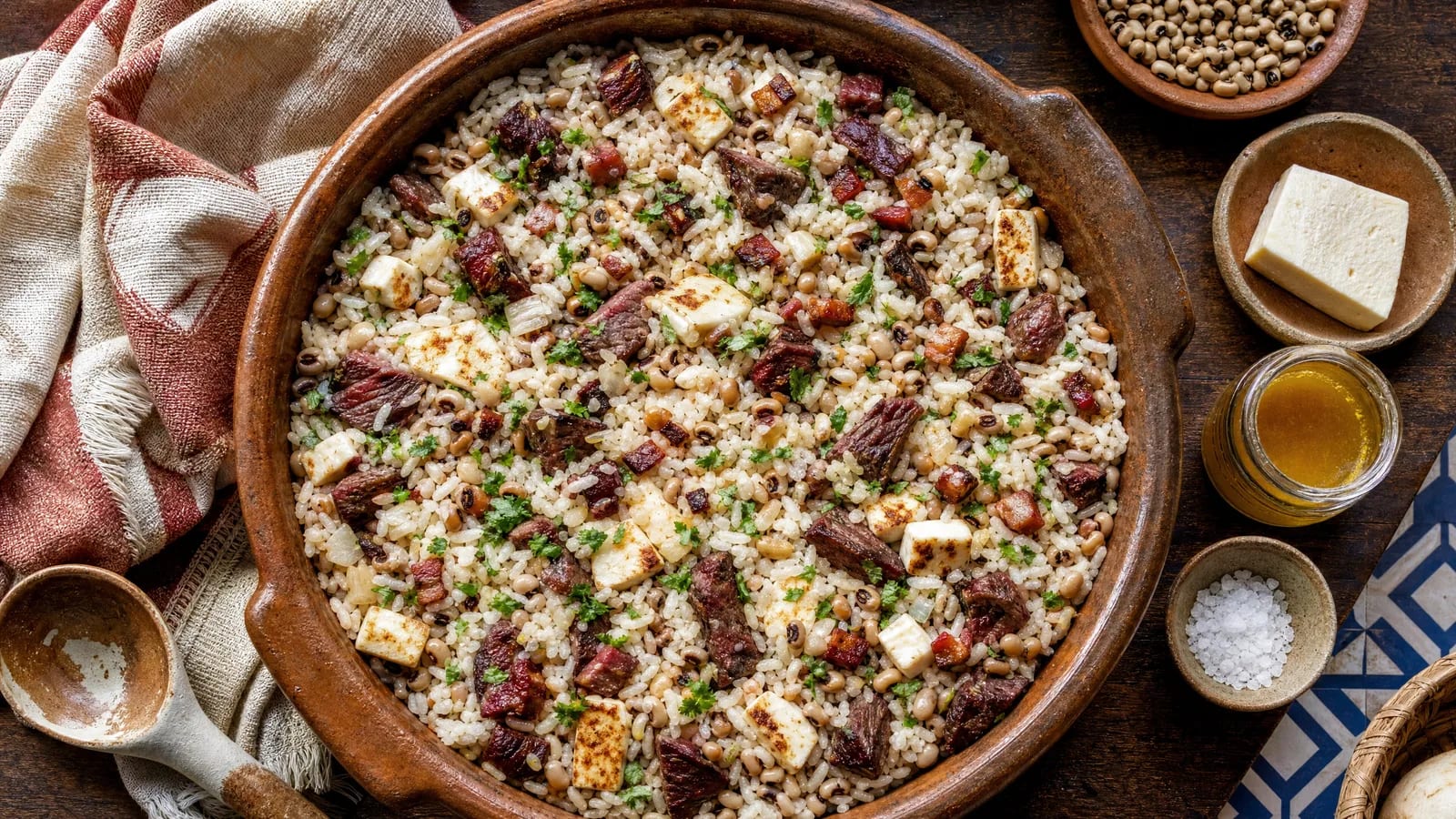
A Northeastern classic brought to Brasília’s tables by the migrant workers who came to build the capital, baião de dois—rice and beans cooked together with cheese and curd—brings cowpeas, rice, carne-de-sol—lightly salted, air-dried beef—, manteiga de garrafa, and queijo coalho together in a single pot.
Behind the flavor
Baião de dois belongs to the Northeast, not to the Federal District by birth. Its strength in Brasília tells a larger story: the workers who came to build the capital also brought their beans, their methods for preserving meat, and their festivities. At markets and in satellite cities, this moist pot of rice and beans still recalls how candango food was shaped by departures, work, and encounter.
📜 Ingredients
- •dried cowpeas1 1/2 cups, about 300 g (10.5 oz)
- 🥩carne-de-sol400 g (14 oz)🔁 desalted charque — The flavor will be more cured and saltier; desalt it carefully before cooking.
- •white rice1 1/2 cups, about 270 g (9.5 oz)
- 🧄queijo coalho, cubed200 g (7 oz)🔁 firm queijo minas padrão — It melts more and has less spring, with a milder, less milky and salty flavor.
- 🧈manteiga de garrafa2 tablespoons🔁 regular butter — Regular butter provides fat, but lacks the characteristic toasted note.
- •diced bacon100 g (3.5 oz)
- •chopped onion1 medium onion
- •chopped garlic3 cloves
- •seeded, chopped tomato1 medium tomato
- •chopped cilantro1/2 cup
- •chopped scallions1/4 cup
- •hot waterenough to cook the beans and keep the rice moist
- •salt and black pepperto taste
👨🍳 Method
- 1
Rinse the cowpeas, cover them with plenty of water, and soak for 8 hours. At the same time, taste a small piece of carne-de-sol: if it is very salty, soak it in cold water in the refrigerator for 4–8 hours, changing the water two or three times. Drain everything before cooking.
Carne-de-sol varies greatly from one producer to another; desalting by taste prevents an overly salty baião.
- 2
Cook the cowpeas in a pressure cooker, covered with fresh water, for 12–15 minutes after it reaches pressure, until tender but still intact. Let the pressure release, drain, and reserve 2 cups of the cooking liquid. Cut the carne-de-sol into strips, cover with fresh water, and cook over medium heat for 25–35 minutes, until tender; drain and shred or chop.
The reserved cooking liquid is part of the recipe: it gives body to the rice and brings the two grains together.
- 3
Heat the manteiga de garrafa in a large pot over medium heat. Fry the bacon for 4–6 minutes, until golden and rendered. Add the carne-de-sol and sauté for 3–5 minutes, until the edges are browned. Remove a spoonful of fat if there is an excess.
Bacon fat is a common variation; for a less intense pot, halve the bacon and keep the manteiga de garrafa.
- 4
In the same pot, sauté the onion for 3 minutes, until translucent, then the garlic for 30 seconds. Add the tomato and cook for 2 minutes, until it begins to break down. Add the rice and stir for 1 minute, coating the grains in the fat and aromatics.
Do not add salt at this stage: the carne-de-sol and queijo coalho already bring salt.
- 5
Stir in the cowpeas and carne-de-sol. Add the reserved cooking liquid and enough hot water for the liquid to stand about 1 cm (3/8 in) above the grains. Cook over low heat, with the pot partially covered, for 15–18 minutes, until the rice is tender and the whole dish is moist, with no loose broth.
If it dries out before the rice cooks, drizzle in more hot water a little at a time; the result should be creamy and cohesive, not soggy.
- 6
Turn off the heat and fold in the queijo coalho, cilantro, and scallions. Cover for 3–5 minutes, just until the cheese warms through and softens at the edges. Taste, adjust the pepper and salt only if needed, and serve at a candango table, where sharing matters as much as the pot itself.
Queijo coalho should hold its shape; that is why it goes in off the heat.
🥃 Pairing
With cachaça
Oak-aged cachaça
Aged and woody, with vanilla, caramel, and moderate tannins.
Its full-bodied profile stands up to the salt and fat of the carne-de-sol, while its wood notes complement the manteiga de garrafa.
Amburana-aged cachaça
Intensely aged, with notes of clove, cinnamon, and vanilla.
The wood’s spices speak to the cilantro and queijo coalho; serve a small pour so as not to cover the cowpeas.
Also pairs well with
✈️ A flavor worth the trip
In Brasília, seek out cowpeas, manteiga de garrafa, and queijo coalho at markets in the administrative regions: each stall helps tell the story of the Northeastern route that arrived with the candangos.
💡 Quick tips
- •Cook the cowpeas until tender yet intact: broken-down beans cloud the baião.
- •Cilantro is an important part of the dish’s aromatic identity; if you do not care for it, use half the amount and make up the rest with scallions.
- •Baião becomes more flavorful after a brief rest, but it should still be served moist.
🤔 Did you know?
The name baião also refers to a Northeastern dance and rhythm; in the dish, rice and beans cook together and seem to follow the same beat.
Small discoveries
- Feijão-de-corda · ingredient
- A pale bean with a dark eye, widely used in Northeastern cooking; when soaked, it cooks more quickly than other beans.
- Manteiga de garrafa · ingredient
- Shelf-stable clarified butter with a more toasted, concentrated aroma, traditional in Northeastern kitchens.
- Queijo coalho · ingredient
- A firm, lightly salty cheese with little melt, known for withstanding heat without completely losing its shape.
- Candango · cultural expression
- A migrant worker associated with the construction of Brasília; today, a word of belonging and pride in the memory of the Federal District.
📚 References
- Receitas Nestlé. Receita de Baião de Dois Tradicional. https://www.receitasnestle.com.br/receitas/baiao-de-dois-tradicional
- CASCUDO, Luís da Câmara. História da Alimentação no Brasil. Global Editora.
- IPHAN. Brasília (DF), patrimônio cultural brasileiro. https://portal.iphan.gov.br/pagina/detalhes/31/
Keep discovering