.webp&w=1920&q=82)
.webp&w=1920&q=82)
.webp&w=1920&q=82)
.webp&w=1920&q=82)
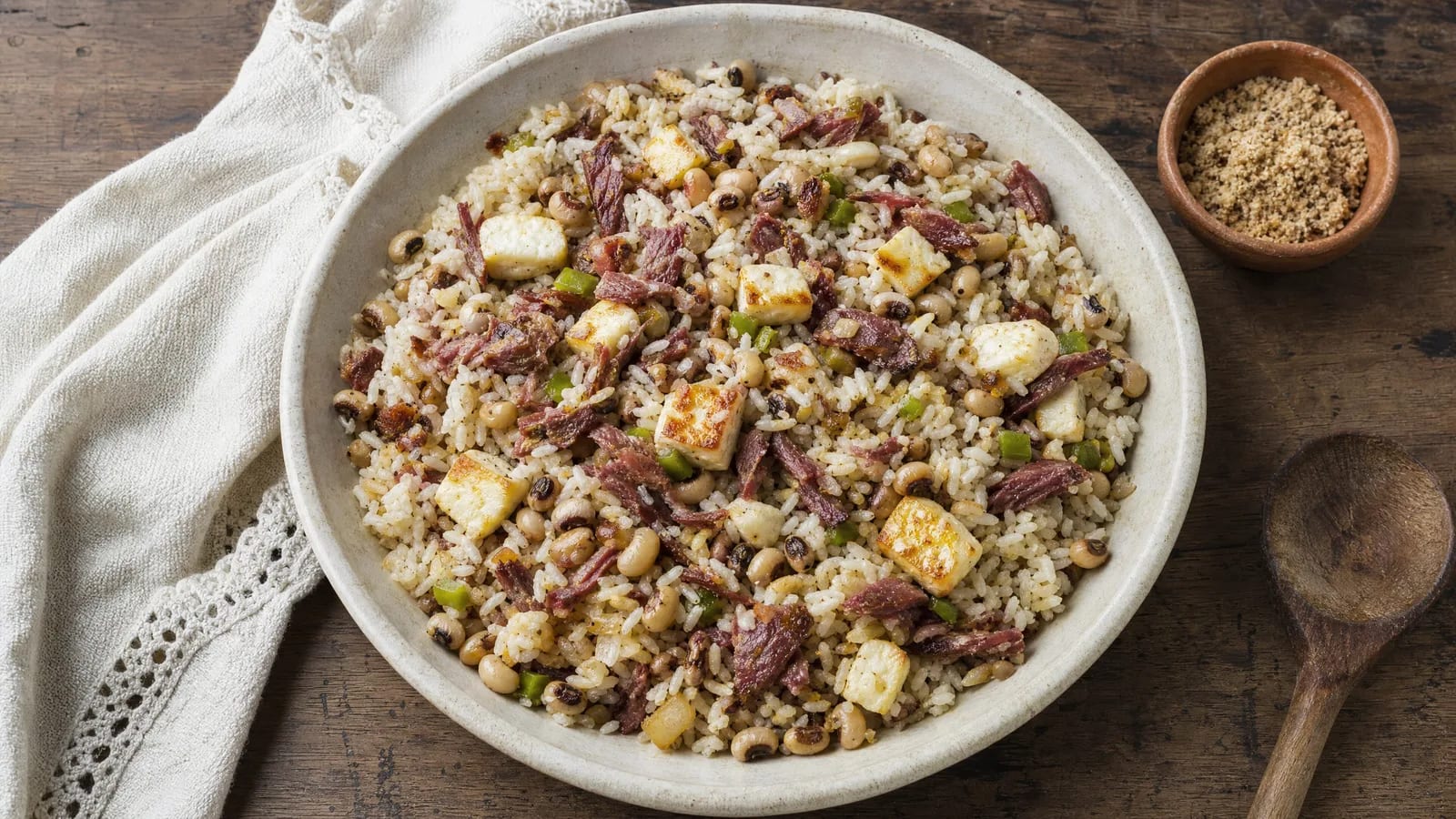
A cornerstone dish of Ceará’s sertão, baião de dois brings rice and cowpeas together in one pot. In this generous version, desalted jabá, manteiga de garrafa, clarified butter aged in a bottle, and queijo de coalho give the meeting substance.
Behind the flavor
Baião de dois was born from the ingenuity of turning pantry staples into a complete meal: beans, rice, fat, and cheese find accord in a single pot. In Ceará, it speaks to sertão cattle raising, cowpeas, and preserving meat with salt. It is sustaining food, but also food of welcome—a dish that reaches the center of the table ready to be shared.
📜 Ingredients
- •Jabá (dried beef), cubed250 g (9 oz)🔁 Carne-de-sol — Carne-de-sol is usually less salty and needs a shorter desalting time, or only a salt adjustment.
- •Dried cowpeas2 cups, about 350 g (12 oz)🔁 Fresh cowpeas or black-eyed peas — Fresh cowpeas cook more quickly; black-eyed peas make a drier dish with a different flavor.
- •White rice1½ cups, about 300 g (11 oz)
- 🧈Manteiga de garrafa3 tablespoons🔁 Good-quality manteiga de garrafa or regular butter — Regular butter works, but lacks the characteristic toasted, dairy-rich aroma.
- •Chopped onion1 large
- •Chopped garlic3 cloves
- •Chopped green bell pepper½ pepper
- 🧄Queijo de coalho, cubed250 g (9 oz)🔁 Halloumi or firm fresh cheese — Halloumi keeps its resilience under heat; fresh cheese melts more and is less springy.
- •Chopped cilantro½ cup
- •Black pepperTo taste
- •SaltOnly if needed, at the end
- •Hot waterEnough to cook the beans, then to cover the rice by about 1 cm (0.4 inch)
👨🍳 Method
- 1
Rinse the jabá (dried beef) under running water, cover it with cold water, and refrigerate for 8–12 hours. Change the water 2 or 3 times. Drain, then pressure-cook in fresh water for 25–35 minutes, until tender; shred or coarsely chop.
Taste a small piece before using it: desalting should reduce excess salt, not erase the meat’s flavor.
- 2
Rinse the dried cowpeas and pressure-cook them in water for 12–15 minutes after the cooker reaches pressure, until tender but not split. Set aside the beans and 4 cups of the hot broth.
For fresh cowpeas, skip the pressure cooker and cook in a regular pot for 20–30 minutes.
- 3
Heat 2 tablespoons of manteiga de garrafa in the saucepan. Brown the jabá for 4–6 minutes, until the edges are toasted. Add the onion, garlic, and bell pepper and sauté for 4 more minutes, until the onion softens.
Manteiga de garrafa should perfume the pan, not smoke; lower the heat if it begins to darken.
- 4
Add the rice and stir for 1 minute, until every grain glistens. Add the cowpeas, black pepper, and 3 cups of the reserved broth, or enough liquid to cover the rice by about 1 cm (0.4 inch). Cook partially covered over low heat for 15–18 minutes, until the rice is tender and the broth has nearly cooked away.
If needed, add more hot broth a little at a time; baião de dois should be moist, not soggy.
- 5
Turn off the heat when the rice is cooked and a sheen of broth still lies between the grains. Fold in the queijo de coalho, cilantro, and remaining tablespoon of manteiga de garrafa. Cover and let rest for 5 minutes, until the cheese is warm and soft at the edges.
Adjust the salt only after adding the jabá and queijo de coalho, both naturally salty.
- 6
Serve Ceará-style baião de dois hot, directly from the pot, in generous spoonfuls that bring together rice, beans, jabá, and cheese. Tradition calls for a shared table, without separating what was made to cook together.
Carne-de-sol, nata, or sausage may appear in home variations, but they are not essential to this version’s identity.
🥃 Pairing
With cachaça
Intensely amburana-aged
Clove, cinnamon, and vanilla notes with a soft texture.
Its spiced sweetness plays with the queijo de coalho and manteiga de garrafa, while its structure stands up to the jabá.
Oak-aged/woody
Vanilla, light caramel, and discreet tannin.
Its restrained wood helps cut through the fat without concealing the cowpeas.
Also pairs well with
✈️ A flavor worth the trip
Look for cowpeas, manteiga de garrafa, and queijo de coalho at a Ceará market: in their aroma and texture, these ingredients reveal the passage from sertão to pot.
💡 Quick tips
- •Plan the desalting the day before; it is part of the preparation, not an optional shortcut.
- •Keep the bean broth hot so you can correct the rice’s cooking without interrupting the simmer.
- •Avoid stirring too much once the rice goes in: it breaks the grains and makes the baião pasty.
- •For a meatless version, omit the jabá and use vegetable broth; the beans, manteiga de garrafa, and queijo de coalho still carry the dish.
🤔 Did you know?
The name baião de dois describes the meeting of two pantry pillars: rice and beans. The dish does not depend on a single kind of meat; what defines it is their shared cooking, in which one grain takes on the flavor of the other.
Small discoveries
- Jabá (carne seca) · ingredient
- Beef preserved through salting and drying; in the sertão, it is also called jabá.
- Manteiga de garrafa · ingredient
- A clarified butter with a pronounced aroma, traditional in Northeastern Brazilian cooking.
- Baião de dois · cultural expression
- The name of a Northeastern Brazilian dish that cooks rice and beans together, in many regional variations.
📚 References
- Universidade Federal do Ceará (UFC), Repositório Institucional, "A cozinha cearense na gastronomia brasileira": https://repositorio.ufc.br/handle/riufc/42698
- Câmara Cascudo, Luís da, "História da Alimentação no Brasil".
- IBGE, panorama e dados gerais do estado do Ceará: https://www.ibge.gov.br/cidades-e-estados/ce.html
- Ficha do Estado — Ceará, fornecida pelo projeto Sip Dölyn, curada em 10 de junho de 2026.
Keep discovering