.webp&w=1920&q=82)
.webp&w=1920&q=82)
.webp&w=1920&q=82)
.webp&w=1920&q=82)
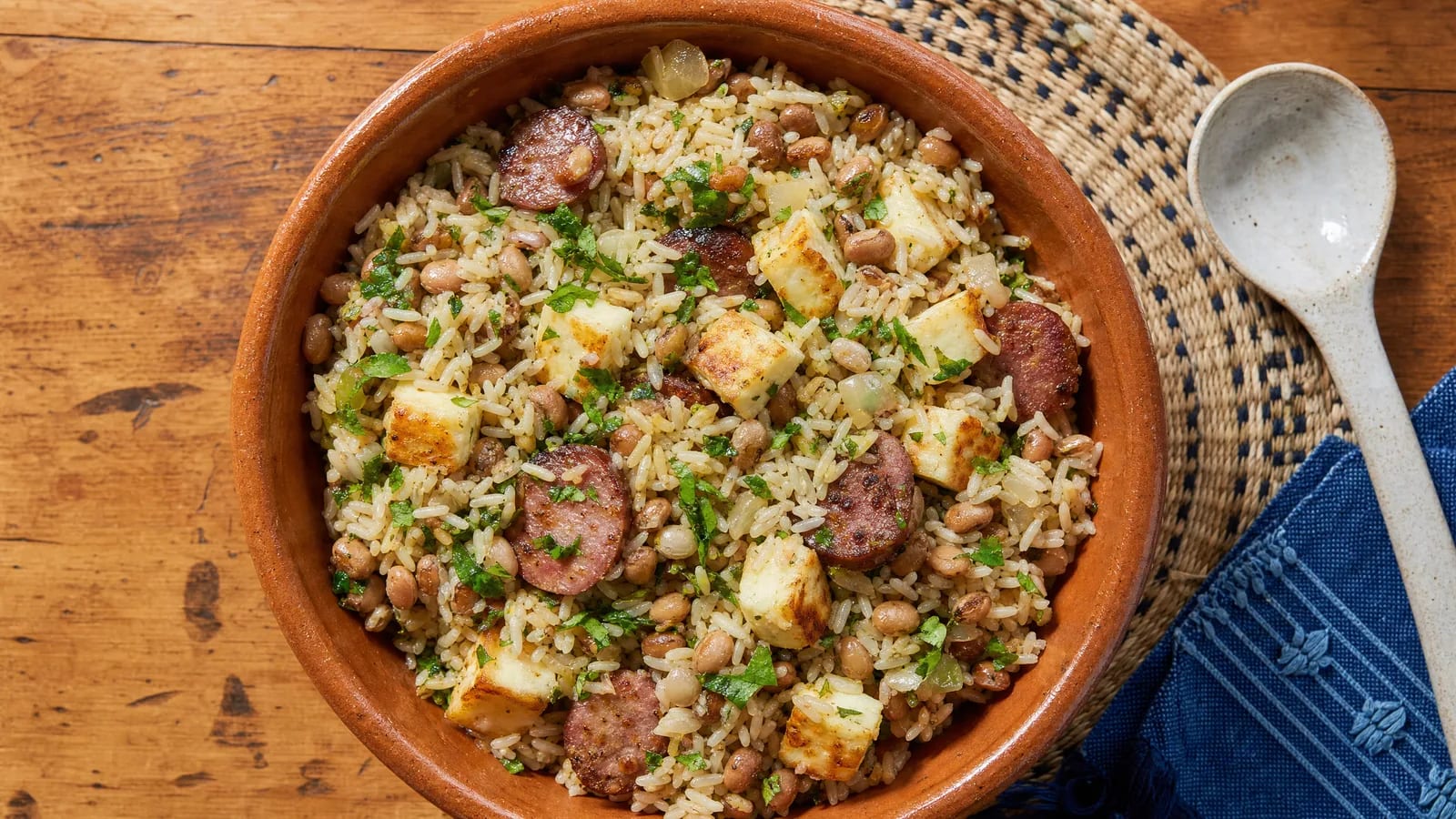
Baião de dois — rice and beans cooked together with cheese and curd — brings rice and cowpeas into the same broth, finished with manteiga de garrafa, cilantro, and queijo de coalho. This classic from Brazil’s Northeast belongs to Pernambuco’s everyday and celebratory cooking.
Behind the flavor
Baião de dois was born in the sertão — Brazil’s semi-arid backlands — of Ceará and spread as one of the Northeast’s most beloved dishes. In Pernambuco, it belongs at market tables, countryside lunches, and São João cooking, where ingredients with deep regional roots — beans, rice, manteiga de garrafa, and queijo de coalho — become both sustenance and celebration. Its strength lies in the gathering: two grains, one pot, and countless family variations.
📜 Ingredients
- •dried cowpeas2 cups, about 360 g (13 oz)🔁 dried black-eyed peas — They cook similarly, with a slightly different flavor.
- •waterenough to cover the dried cowpeas by 4 cm (1 1/2 in), then to replenish the broth
- •long-grain rice1 1/2 cups, about 270 g (9 1/2 oz)
- 🧄queijo de coalho250 g (9 oz), cut into 1.5 cm (1/2 in) cubes🔁 halloumi — It holds its shape better, but is saltier and has a different dairy flavor.
- 🧈manteiga de garrafa3 tablespoons🔁 clarified unsalted butter — It keeps the rice glossy but softens its distinctive aroma.
- •smoked calabresa sausage250 g (9 oz), thinly sliced into half-moons
- •onion1 large, finely diced
- •garlic4 cloves, chopped
- •tomatoes2 ripe, seeded and diced
- •green bell pepper1/2, finely diced
- •cilantro1/2 small bunch, chopped
- •black pepperto taste
- •saltto taste, adjusted at the end
👨🍳 Method
- 1
Rinse the dried cowpeas and soak them in water for 2 hours, if time allows. Drain, cover with fresh water, and cook in a pressure cooker for 12 to 15 minutes after it reaches pressure, or in a regular pot for 35 to 45 minutes, until tender but still intact. Set the beans and broth aside separately.
Dried cowpeas cook faster than other beans; start checking early to keep the beans whole.
- 2
In the wide pot, heat 1 tablespoon of manteiga de garrafa over medium heat for 1 minute. Brown the calabresa sausage for 4 to 6 minutes, until it renders its fat and develops browned edges. Remove with a slotted spoon and set aside.
Calabresa sausage is a popular variation; for a meatless baião, omit it and add 1 extra tablespoon of manteiga de garrafa.
- 3
In the same pot, add 1 more tablespoon of manteiga de garrafa, the onion, garlic, and green bell pepper. Sauté over medium heat for 5 to 7 minutes, until the onion is soft and fragrant. Add the tomatoes and cook for 3 minutes more, until they begin to break down.
Keep the heat at medium so the garlic perfumes the dish without turning bitter.
- 4
Add the long-grain rice and stir for 1 to 2 minutes, until the grains are glossy. Add 3 cups of the hot bean broth, or enough to cover the rice with about 1 cm (3/8 in) of liquid, and return the calabresa sausage to the pot.
If there is not enough bean broth, add hot water; the liquid must stay hot so the cooking is not interrupted.
- 5
Cover partially and cook over low heat for 12 to 16 minutes, until the rice has absorbed nearly all the broth and is tender. In the final 4 minutes, gently fold in the cooked cowpeas; if the pot dries before the rice is done, add small ladles of hot broth.
Baião de dois should be moist and bound by its broth, not fluffy like party rice or soupy like a stew.
- 6
Turn off the heat. Stir in the final tablespoon of manteiga de garrafa, the cilantro, black pepper, and half the queijo de coalho. Cover and let rest for 5 minutes, until the cheese softens and the baião de dois settles.
Warm the cheese only with the residual heat so it yields to the fork without melting completely.
- 7
Taste and adjust the salt only now. Serve topped with the remaining queijo de coalho, bringing the baião de dois to the table as a dish of gathering, so closely tied to the pots of the sertão and to Northeastern celebrations.
A tomato salad or a serving of boiled cassava refreshes and rounds out the meal.
🥃 Pairing
With cachaça
Light yellow/rested cachaça from Pernambuco
Smooth, with subtle wood and a clean finish
It follows the creamy texture of the rice and cowpeas without weighing down the cilantro and queijo de coalho.
White/silver cachaça from a Pernambuco alambique
Herbal, fresh, citrusy, and served chilled
It brings a refreshing contrast to the manteiga de garrafa and calabresa sausage, cleansing the palate between bites.
Also pairs well with
✈️ A flavor worth the trip
Try buying queijo de coalho and manteiga de garrafa at a Pernambuco market. They turn the same pair of rice and beans into a memory specific to Brazil’s Northeast.
💡 Quick tips
- •Use the cooking broth from the dried cowpeas to give the rice its character.
- •Leave the salt until the end, since calabresa sausage and queijo de coalho already season the dish.
- •If you find fresh green cowpeas, skip the soaking and shorten the cooking time until they are tender.
- •A 5-minute rest with the pot covered makes the baião de dois more cohesive and fragrant.
🤔 Did you know?
The name baião de dois echoes baião, the musical rhythm popularized by Luiz Gonzaga; in 1950, the song “Baião de Dois” helped make enduring the image of cowpeas and rice brought together in one pot.
Small discoveries
- Feijão-de-corda seco · ingredient
- A pale bean with a dark eye, widely used in Brazil’s Northeast and also called a black-eyed pea in some places.
- Queijo de coalho · ingredient
- A firm dairy cheese suited to browning or heating without immediately falling apart.
- Manteiga de garrafa · ingredient
- A deeply aromatic clarified butter used for cooking and finishing Northeastern Brazilian dishes.
- Baião de dois · cultural expression
- A Northeastern Brazilian dish that brings rice and beans together in one pot; its name echoes baião, a rhythm popularized by Luiz Gonzaga.
- Sertão · cultural expression
- A semi-arid interior that brings together landscapes, farming practices, and culinary memories central to Brazil’s Northeast.
📚 References
- Guia Michelin — “Baião de dois: muito mais do que feijão e arroz”, 2023. https://guide.michelin.com/br/pt_BR/article/news-and-views/baiao-de-dois-muito-mais-do-que-feijao-e-arroz
- Instituto Federal de Pernambuco (IFPE), Repositório Institucional — GODOY, Hugo Georeg Ferreira. Festival Gastronômico — Cheio de Fome: uma viagem pela gastronomia pernambucana, 2021. https://repositorio.ifpe.edu.br/xmlui/handle/123456789/608
- CASCUDO, Luís da Câmara. História da Alimentação no Brasil. São Paulo: Global Editora.
- FICHA DO ESTADO — PERNAMBUCO, base curada fornecida para o Sip Dölyn, 2026.
Keep discovering