.webp&w=1920&q=82)
.webp&w=1920&q=82)
.webp&w=1920&q=82)
.webp&w=1920&q=82)
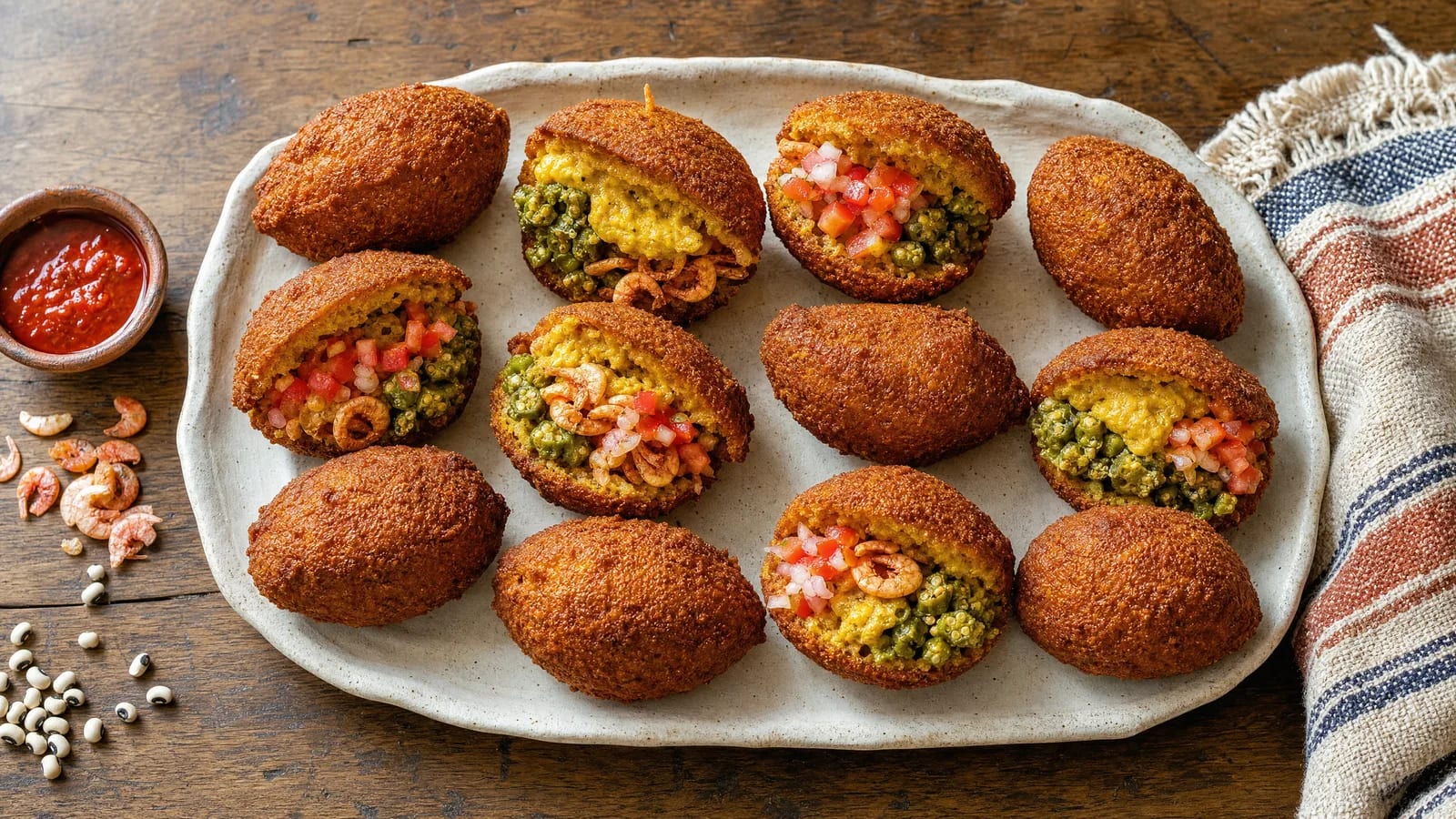
Acarajé — a black-eyed pea fritter fried in dendê oil — is made from hulled, ground black-eyed peas and split to receive vatapá, caruru, dried shrimp, salad, and chile sauce served on the side.
Behind the flavor
In Salvador’s streets, squares, markets, and celebrations, acarajé brings together culinary technique, women’s work, and knowledge rooted in Africa. IPHAN recognizes the Craft of the Baianas de Acarajé — the women who fry and sell acarajé in Bahia — as Brazilian Cultural Heritage: selling from the tabuleiro preserves a practice passed down through generations, linked to urban life and the religious contexts of candomblé. In this version for sale, the fillings are part of the experience; in religious ceremonies, preparation and service follow their own guidance and must not be simplified.
📜 Ingredients
- •dried black-eyed peas500 g (18 oz)🔁 None recommended — Any other bean changes the dough, its natural fermentation, and the identity of acarajé.
- •white onion1/2 medium, cut into pieces
- •salt1 teaspoon, or to taste
- •dendê oilabout 1.5 liters (6 cups), enough for a depth of 5–6 cm (2–2 1/2 inches) in the pot🔁 neutral vegetable oil — It fries the dough but does not provide the fragrance, color, or flavor that define acarajé.
- •vatapá250 g (9 oz), prepared and hot🔁 None recommended — The filling may be omitted, but there is no equivalent flavor.
- •caruru250 g (9 oz), prepared and hot🔁 None recommended — The filling may be omitted, but its okra texture is distinctive.
- •dried shrimp80 g (3 oz), heads removed🔁 None recommended — Without it, acarajé loses the filling’s traditional note of the sea.
- •tomato1 small, seeded and chopped
- •red onion1/4 small, finely chopped
- •cilantro1 tablespoon, chopped
- •lime juice1 tablespoon
- •malagueta chile sauce1 small sauce dish, served on the side🔁 chile sauce of your choice — The aroma changes, but each diner can still choose their own level of heat.
👨🍳 Method
- 1
Wash the black-eyed peas and soak them in cold water for 8–10 hours. Drain, then rub the beans between your hands in a bowl of water to loosen their skins; discard the skins little by little, repeating until most beans are hulled.
Discarding the skins takes patience: they rise to the surface and come away more easily with several changes of water.
- 2
Process the hulled black-eyed peas with the onion and 2–4 tablespoons water, using only enough to form a very smooth, thick paste. Transfer to a bowl, add the salt, and beat vigorously with a wooden spoon for 8–10 minutes, until the batter lightens in color and becomes airy.
The batter should fall from the spoon in a soft mass, not run like pancake batter.
- 3
Make the salad by mixing the tomato, red onion, cilantro, and lime juice; set aside. Heat the vatapá and caruru in separate pans over low heat for 5–8 minutes, until hot. If desired, quickly rinse the dried shrimp and dry it before serving.
The fillings go in at the end; heating them beforehand keeps the acarajé from cooling once it is split open.
- 4
Heat the dendê oil in a deep pot to 175–180 °C (350–355 °F) over medium heat, until a small portion of batter rises surrounded by steady bubbles. Using two spoons, shape oval portions of about 45 g (1 1/2 oz) and fry only a few at a time for 6–8 minutes, turning once, until puffed and evenly golden.
Do not crowd the pot: a sharp drop in temperature makes the fritters heavy and oily.
- 5
Drain the acarajés for 1 minute on a rack or paper towels. Cut a side opening without separating the two halves and fill, in this order, with vatapá, caruru, dried shrimp, and salad; it is the assembly recognized at the tabuleiro. Serve the malagueta chile sauce on the side.
The request for heat should be the eater’s choice; keep the chile out of the main filling.
🥃 Pairing
With cachaça
Bahian white/silver cachaça from an alambique
Vegetal, citrusy, and served well chilled
Its acidity and freshness cut through the fragrant richness of dendê oil between bites without masking the black-eyed peas.
Cravinho, cachaça infused with cloves and spices
Spiced, dry, and aromatic
It is a traditional Salvador pairing; its spice speaks to the dried shrimp and malagueta chile sauce. Serve in a small pour.
Also pairs well with
✈️ A flavor worth the trip
In Salvador, seek out a baiana de acarajé’s tabuleiro and watch the made-to-order assembly: dendê, vatapá, caruru, and the question about chile form a small urban choreography.
💡 Quick tips
- •Use fresh dendê oil with a clean aroma; oxidized oil turns bitter and weighs down the result.
- •Fry one test fritter before shaping the batch: if it splits open, beat the batter longer; if it is dense, incorporate air with a few more minutes of beating.
- •Serve as soon as the fritters are fried; the crust loses its contrast when the fritter remains closed and steamy.
🤔 Did you know?
IPHAN’s description records that the traditional technique involves washing, hulling, grinding, seasoning, and shaping the black-eyed peas before frying them in dendê oil — a sequence of work that explains why acarajé batter is not a simple bean fritter.
Small discoveries
- Feijão-fradinho · ingredient
- A small, pale legume also known as feijão-de-corda in some regions; it is the base of acarajé batter.
- Azeite de dendê · ingredient
- An orange oil pressed from the fruit of the dendê palm, with a pronounced fragrance and a central place in Bahian cooking.
- Tabuleiro · cultural expression
- A stall arranged by a baiana de acarajé to prepare and sell acarajé and other traditional foods in public spaces.
- Vatapá · ingredient
- A thick Bahian cream prepared in versions with bread or flour, dried shrimp, coconut milk, peanuts or cashews, and dendê oil.
- Caruru · ingredient
- A Bahian okra preparation, usually enriched with dried shrimp and dendê oil.
📚 References
- Instituto do Patrimônio Histórico e Artístico Nacional (IPHAN) — Ofício das Baianas de Acarajé, registro no Livro dos Saberes, 2005, revalidado em 2022: https://bcr.iphan.gov.br/bens-culturais/oficio-das-baianas-de-acaraje/
- Vivaldo da Costa Lima — A anatomia do acarajé: um estudo etnográfico da cozinha baiana.
- Câmara Cascudo — História da Alimentação no Brasil.
Keep discovering