.webp&w=1920&q=82)
.webp&w=1920&q=82)
.webp&w=1920&q=82)
.webp&w=1920&q=82)
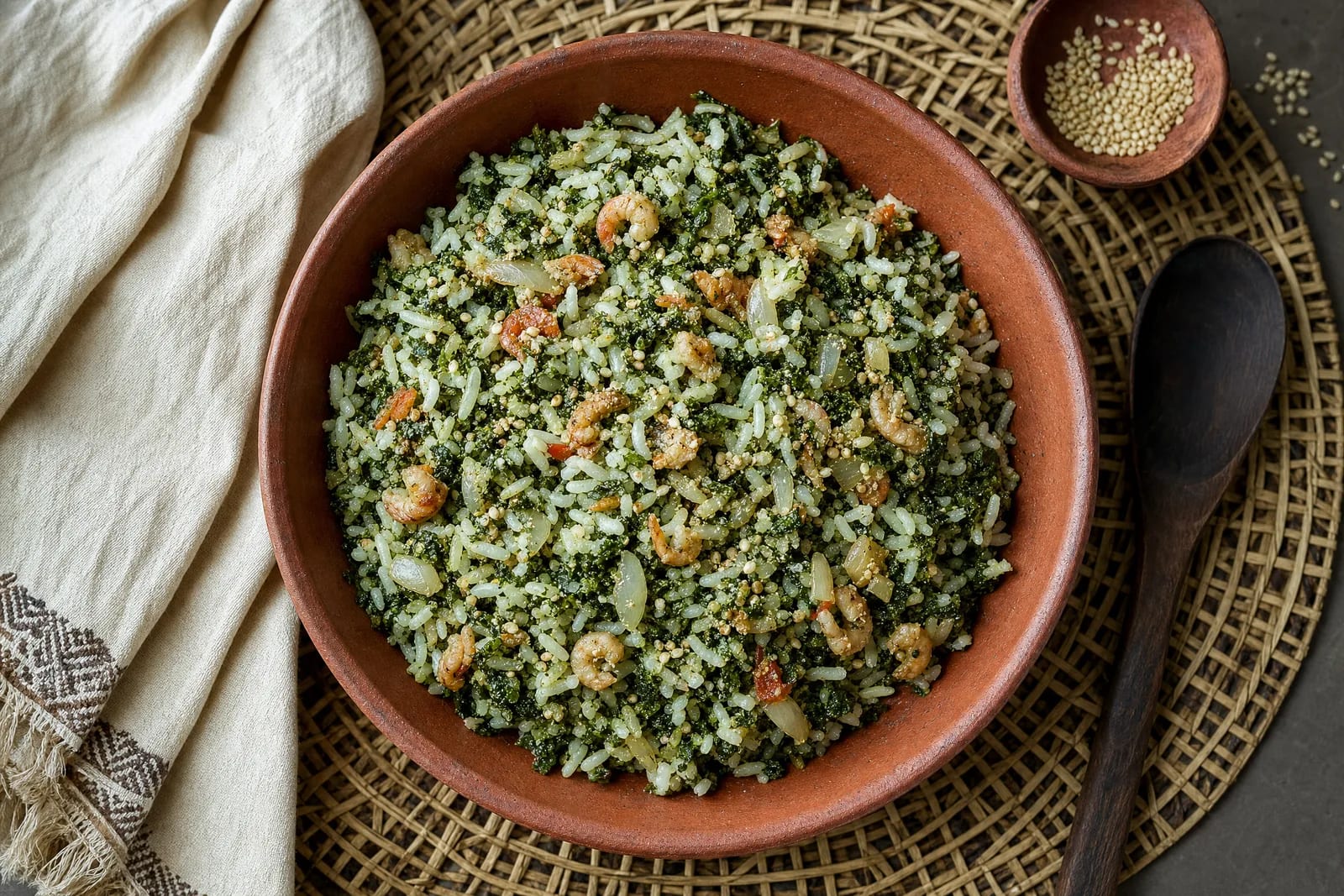
In Maranhão, arroz de cuxá is more than a side dish: it brings rice together with a sauté of vinagreira — the tart leaf of Hibiscus sabdariffa — dried shrimp, toasted sesame, and cassava flour. Served beside fried fish or shrimp, it carries to the table the acidity that has made the cooking of São Luís unmistakable.
Behind the flavor
Cuxá is one of Maranhão's most recognizable table markers. UFMA records its historic connection to vinagreira, dried shrimp, sesame, and cassava flour, placing it among the representative elements of local foodways. By folding this sauté into rice, the dish brings together vinagreira's African heritage, cassava, and the seafood of the great bay in a recipe that has become a symbol of São Luís and Maranhão.
📜 Ingredients
- •white rice2 cups
- •vinagreira2 medium bunches, leaves only🔁 Swiss chard with a few drops of lemon juice — It partly recreates the volume and acidity, but not vinagreira's distinctive vegetal fragrance.
- •dried shrimp150 g (5 oz)🔁 small peeled dried shrimp — Keep the desalting step; the smaller size changes only the texture, not the dish's identity.
- •sesame seeds3 tablespoons
- •fine cassava flour2 tablespoons🔁 very finely ground biju cassava flour — The texture will be more granular; use a small amount so the cuxá does not lose its moisture.
- •onion1 medium, finely chopped
- •garlic2 cloves, chopped
- •tomatoes2 small, seeded and chopped
- •scallions3 tablespoons, sliced
- 🌶️pimenta-de-cheiro1 small, seeded and chopped, or to taste
- •olive oil4 tablespoons
- •waterenough to desalt the shrimp, blanch the vinagreira, and cook the rice
- •saltto taste
👨🍳 Method
- 1
Rinse the dried shrimp under running water. Soak it in enough cold water to cover for 30 to 60 minutes, changing the water once or twice, until the excess salt is reduced. Drain, taste a piece, and set aside.
Desalting is essential: dried shrimp can vary greatly in intensity from one supplier to another.
- 2
Wash the vinagreira. Bring water to a boil in a large pot and add the leaves for 2 to 3 minutes, just until wilted and intensely green. Drain, let cool slightly, and finely chop.
Avoid overcooking: the leaves should retain their acidity rather than turn into a dull paste.
- 3
Toast the sesame in a dry skillet over low heat for 3 to 5 minutes, stirring continuously, until fragrant and lightly golden. Pound or pulse it with half the dried shrimp until it forms a moist, uneven crumb.
Do not toast over high heat; the sesame will turn bitter before it browns evenly.
- 4
Cook the rice in a covered saucepan with enough water to cover it and rise about a finger-width above it. Keep over low heat for 15 to 18 minutes, until the grains are tender and the water has dried up; turn off the heat and let stand for 5 minutes.
Keep the rice fluffy, as it will still absorb moisture from the cuxá.
- 5
Heat the olive oil over medium heat. Sauté the onion for 4 to 5 minutes, until translucent; add the garlic and pimenta-de-cheiro for 1 minute, until fragrant. Add the tomatoes, scallions, and remaining dried shrimp; cook for 3 to 4 minutes, until the tomatoes soften.
Adjust the salt only after the shrimp has warmed through, so the sauté does not become too salty.
- 6
Add the vinagreira, the sesame-shrimp mixture, and the cassava flour. Stir over low heat for 3 to 5 minutes, until the cuxá is moist, cohesive, and free of loose liquid.
The cuxá should be thick but never dry; if needed, add 1 or 2 tablespoons of hot water.
- 7
Fold the cuxá into the cooked rice with a light hand and warm for 2 minutes over low heat, just until everything is hot. Serve immediately.
Traditionally, arroz de cuxá is served with fried fish or fresh shrimp.
🥃 Pairing
With cachaça
White/silver cachaça from an alambique
Young, herbal, and citrusy, served chilled
Its lightness accompanies the shrimp and vinagreira's acidity without obscuring the toastiness of the sesame.
Light/rested yellow cachaça
Smooth, with discreet wood notes
It works when arroz de cuxá is served with fried fish, supporting the fry without competing with the tart leaf.
Also pairs well with
✈️ A flavor worth the trip
At a market in São Luís, seek out vinagreira by its green, tart leaves. It is there that arroz de cuxá ceases to be merely seasoned rice and begins to carry Maranhão's accent.
💡 Quick tips
- •Use dried shrimp from a reliable source and refrigerate it after opening the package.
- •If the vinagreira comes with thick stems, discard them; they make the sauté fibrous.
- •Make the cuxá shortly before serving to preserve the leaf's color and acidity.
- •Home versions vary from household to household: some tables favor a more finely chopped cuxá, others a more rustic one.
🤔 Did you know?
UFMA explains that the name cuxá is related to Kutxá, a term from the Mandinka language; the institution also notes the dish's presence in São Luís restaurants as part of the local diet and memory.
Small discoveries
- Vinagreira · ingredient
- A pleasantly tart leaf of the Hibiscus sabdariffa species, used as the base for cuxá.
- Cuxá · cultural expression
- A Maranhão sauté of vinagreira, toasted sesame, dried shrimp, and cassava flour.
- Camarão seco · ingredient
- Shrimp preserved through drying and salting, with a concentrated flavor.
- Gergelim · ingredient
- An oil-rich seed that brings fragrance and texture to cuxá when toasted.
📚 References
- Universidade Federal do Maranhão (UFMA). Cuxá: tradição e saúde na mesma receita. 2009. https://portais.ufma.br/PortalUfma/paginas/noticias/noticia.jsf?id=7246
- Embrapa Hortaliças. Hortaliças não convencionais. Hortaliças tradicionais: vinagreira. 2017. https://www.embrapa.br/en/busca-de-publicacoes/-/publicacao/1071384/hortalicas-nao-convencionais-hortalicas-tradicionais-vinagreira
- Universidade Federal do Maranhão (UFMA), XV WTICIFES. Gastronomia Maranhense. https://wticifes2023.ufma.br/guia-turistico/gastronomia-maranhense/
Keep discovering