Analysis
The protection that never reaches those who need it most
When South Korea democratized and built labor protection, in 1988, it designed a door with a specific measure: only firms with more than ten employees. Everyone below stayed outside. Brazil has an equivalent door — except it does not measure company size. It measures what the working relationship is called. And 38.5 million people are on the outside of it.
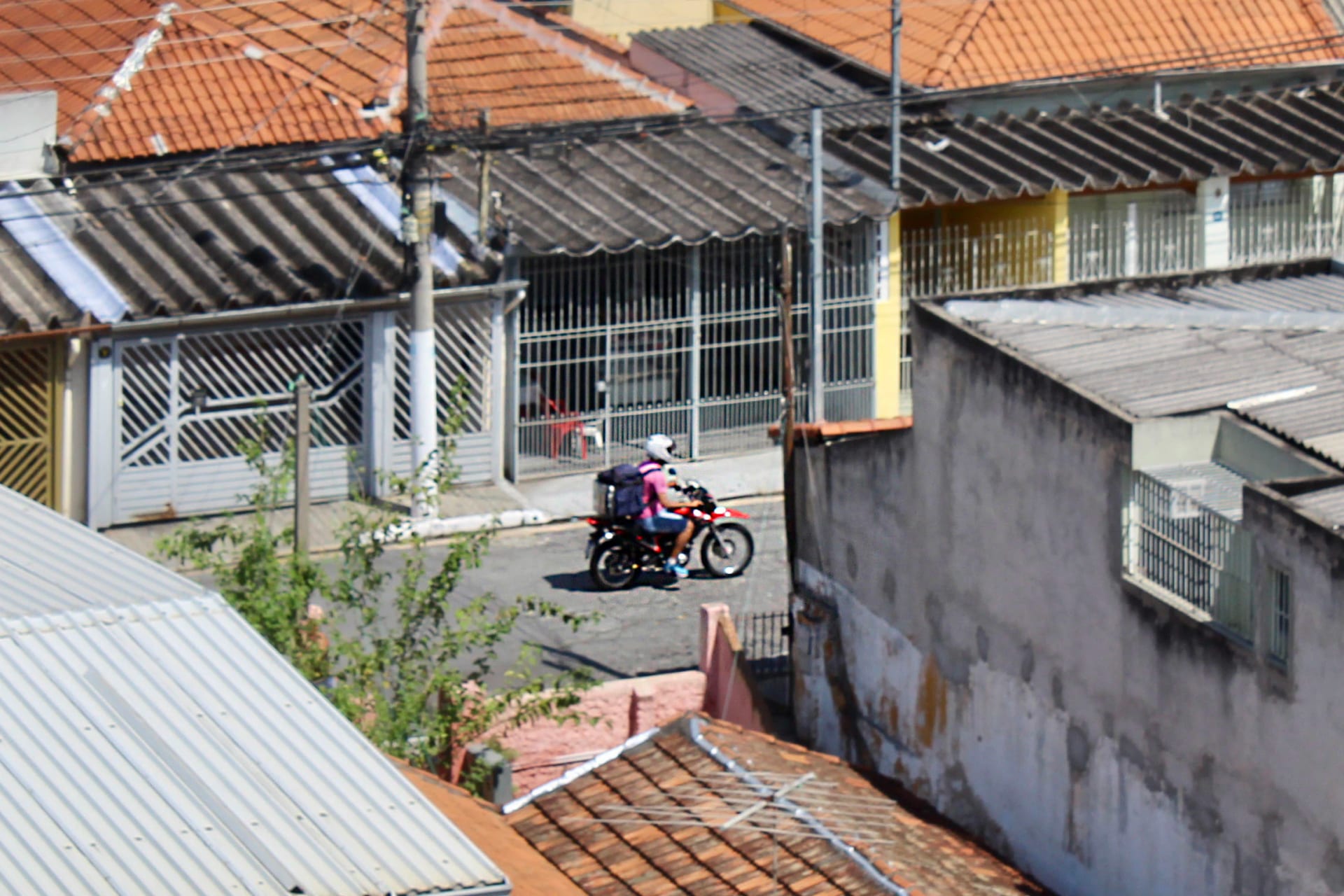
An app delivery worker on the job, March 2021. The photograph is part of a documentary collection on platform work during the pandemic.
Juubritom · CC BY-SA 4.0 · Source
In 1988 and 1989, a newly democratized South Korea built the labor protection that had not existed during the economic miracle. And in building it, the country designed a door with a specific measure: it applied to firms with more than ten employees.
The article that gave rise to this investigation records the consequence in a single line: the protection left out precisely the most precarious. Whoever worked in the eight-person workshop stayed exactly where they were.
The question that remained was whether Brazil has a door like that. It does — and the finding of this investigation is that it is not the same kind of door.
Brazil's threshold does not measure size
Brazilian labor law does not exclude the small firm. The CLT applies to the employee of a microenterprise just as it applies to the employee of an automaker, and the wage floor, the vacation and the thirteenth salary do not depend on how many people work alongside you.
Brazil's threshold is a different one: the category of the working relationship. Anyone with a signed work card is inside. Anyone who is self-employed without a CNPJ, anyone registered as an individual microentrepreneur, anyone providing services through a platform, anyone working without registration — is outside, and not because the firm is small, but because the relationship is not called employment.
The effect is the same as in Korea in 1988: the protection exists, it is real, and it passes right by the people in the worst position. Only the criterion for exclusion has migrated from the org chart to the contract.
How many are on the outside
Informality rate in the Brazilian labor market (% of the employed population)
View the data
| Period | Informality rate |
|---|---|
| 2024 (year) | 39 |
| 2025 (year) | 38.1 |
| Q3 2025 | 37.8 |
| Q4 2025 | 37.6 |
| Nov/25–Jan/26 | 37.5 |
Informality has been falling since 2022, and the quarter ending in January 2026 recorded the lowest level since July 2020 — which still corresponds to 38.5 million people.
Elaboração Sip Dölyn com dados da PNAD Contínua (IBGE). · Source
Brazil's informality rate fell from 39.0% in 2024 to 38.1% in 2025, and reached 37.5% in the quarter ending in January 2026 — the lowest level since July 2020. It is a real improvement, and it has been falling since 2022.
And it still means 38.5 million people working outside the door, in a country with 103 million employed — the largest contingent ever recorded. Practically four in ten.
The new door: platform work
If Korea in 1988 excluded people by the size of the workshop, Brazil in the 2020s has acquired a form of exclusion that existed in neither country: work intermediated by an app, in which the very existence of an employment relationship is in dispute.
IBGE has begun to measure this. In 2024, 1.7 million people were working through digital platforms — 25.4% more than in 2022. In the first measurement, in 2022, there were 704 thousand app drivers and 589 thousand delivery workers.
| Indicator (app drivers, 2022) | Value |
|---|---|
| Average weekly hours | 47.9 hours |
| Average real monthly earnings | R$ 2,454 |
| Average hourly earnings | R$ 11.80 |
The 47.9-hour workweek exceeds the 44 hours the Constitution sets as the limit for work under a formal employment relationship — a category to which these workers, in most cases, do not belong.
Elaboração Sip Dölyn com dados do módulo de trabalho em plataformas digitais da PNAD Contínua (IBGE). · Source
The reading this investigation proposes — and it is Sip Dölyn's own — is that the figure of 47.9 hours is the most informative one in the table. It describes a workweek above the constitutional ceiling of 44 hours, worked by people who are formally outside the category the ceiling protects. This is not a loophole in the law: it is the law applied to a relationship it does not classify as employment.
What the comparison illuminates, and what it does not prove
The original article makes an argument worth repeating precisely: Korea industrialized at the cost of a human toll made visible by the accident and mortality figures, and protection arrived afterward, with democratization — and it arrived only halfway.
The temptation would be to conclude that Brazil is on the same track. That is not what the data support, and this is the honest limit of this article. The Korea of that period had explosive industrial growth and almost no protection; Brazil today has extensive protection on the books, falling informality and modest industrial growth. These are different situations.
What the comparison illuminates is narrower, and more useful: to design protection by category is to design who is left outside it. Korea chose company size and created a class of unprotected workers below the line. Brazil chose the nature of the working relationship, and the result comes to nearly forty million people.
The social protection that came with democratization covered only firms with more than ten employees, leaving out precisely the most precarious.
Every line that defines who is protected also defines who is not. Korea's was numerical, and you could see it. Brazil's is contractual, and therefore harder to see — but it appears in full the moment someone asks how many hours a week are worked by a person the law does not call an employee.
Where this investigation came from
This story grew out of a question raised while we were producing South Korea didn't get rich because it studied — it studied because it got rich.
Sources and method
The information in this article was gathered from the sources listed below, with cross-referencing of public data and academic review.
- Instituto Brasileiro de Geografia e Estatística (IBGE). PNAD Contínua: taxa de informalidade e população ocupada, 2024-2025, IBGE, 2026. Open
- Instituto Brasileiro de Geografia e Estatística (IBGE). Número de trabalhadores por aplicativos cresceu 25,4% entre 2022 e 2024, IBGE — módulo de trabalho em plataformas digitais da PNAD Contínua, 2025. Open
- Instituto Brasileiro de Geografia e Estatística (IBGE). Trabalho por meio de plataformas digitais — resultados do módulo suplementar, IBGE, 2024. Open
Keep reading
- Why the best technology usually losesTechnical superiority is a weak criterion for predicting an invention's fate. What matters is who is already locked into the current standard, who loses income from the switch, which routines would have to be remade—and who bears the cost of the first step.
- The Math Nobody Does: Why 'Buy 3, Pay 2' Convinces Even With a Small DiscountA three-for-two offer is two things at once: simple arithmetic that almost nobody does in the supermarket aisle and a pricing tool that separates customers without announcing different prices. What happens in a buyer's head—and what the seller is buying with that discount.
- Why the Producer Sells Raw Material and the Consumer Buys MeaningThe gap between the price of a sack and the price of a cup is neither accident nor malice. It is the result of three machines operating simultaneously: one that sets commodity prices, another that distributes bargaining power throughout the chain, and a third that manufactures meaning — and only the last one has margin, because only it produces something that cannot be substituted.